 ™
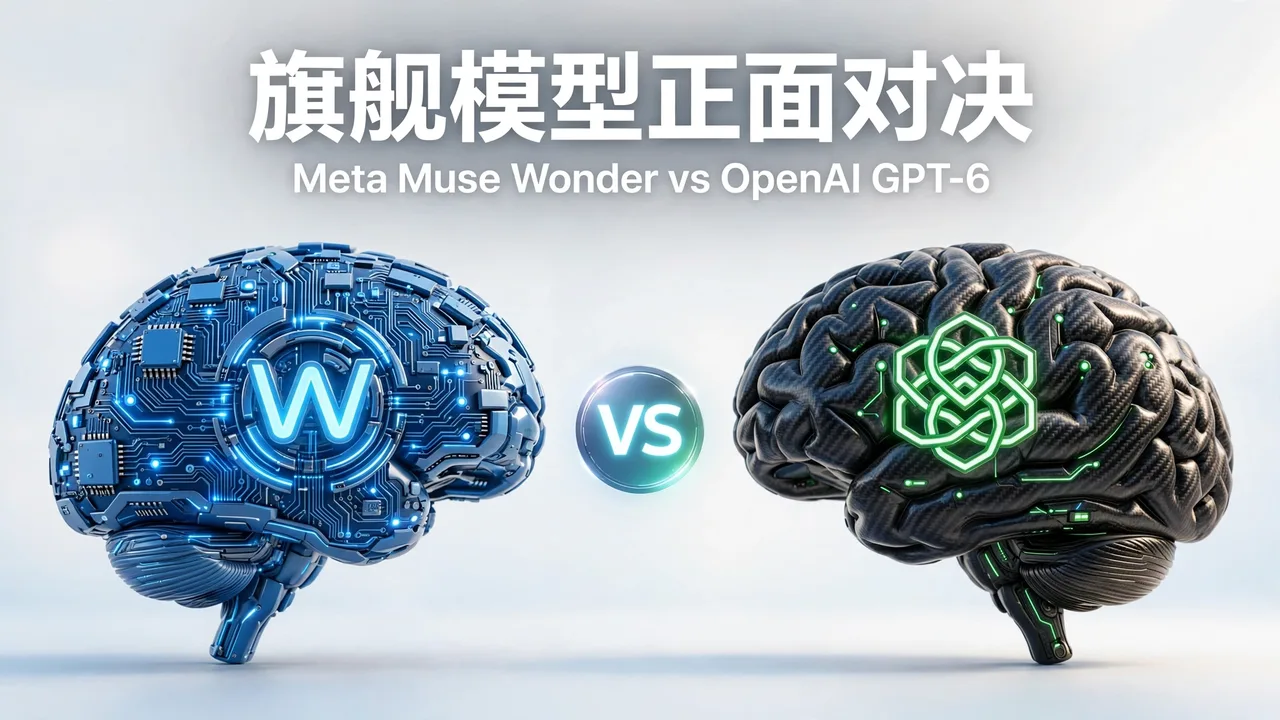
™Muse Wonder vs GPT-6: Two Flagships Meet in One Week
In the second week of October, Meta and OpenAI each shipped a flagship: Meta's Muse Wonder launched October 12 with pay-per-use API pricing; OpenAI's GPT-6 reached every ChatGPT tier from October 7, turning answers from plain text into interactive interfaces.
Latest
1 updates · newest first-
Compare published: Muse Wonder vs GPT-6.
Further updates will appear here
Side by side
✓ marks the side that wins the row| Item | Muse Wonder | GPT-6 |
|---|---|---|
| Release date | October 12, 2026, announced by Meta | October 7, 2026, announced by OpenAI |
| Price & access | $4 input / $20 output per million tokens ($0.20 cached); Wonder Full only via Muse Code subscription ($50/$200 per month) | Available in every ChatGPT tier: paid tiers get GPT-6 Sol, Free/Go get GPT-6 Luna; Intelligent UI in all tiers |
| Artificial Analysis Intelligence Index | 52 (Muse Wonder; Wonder Full 56, not on the API) | 53 (GPT-6 Astra)✓ |
| Key new feature | Active Memory (cross-session memory) + Active Focus (task completion) | Intelligent UI (answers mix text, charts, buttons and tools; Chat tab only) |
| Vendor-reported performance | DeepSWE 78.8, SWE-Marathon 53.1, above Claude Opus 5.5 (Meta model card) | Web-search questions answered 44% sooner on average (OpenAI internal evaluation) |
Verdict
How to choose: developers calling APIs per token can work from Muse Wonder's published pricing ($4/$20 per million tokens); everyday ChatGPT use — including the free tier — gets GPT-6 Luna with Intelligent UI.
01What they are
Muse Wonder is the model family Meta Superintelligence Labs launched on October 12, comprising the standard Muse Wonder and the more capable Muse Wonder Full. Meta is not releasing the weights: the standard model is sold per token through the Meta Model API, while the stronger version is reserved for paid Muse Code subscribers. Meta highlights two capabilities — Active Memory (retaining conversation history, preferences and habits across sessions) and Active Focus (carrying complex or ambiguous tasks through to completion); the models support 1M-token context and accept text, image, video and audio input.
GPT-6 is the model family OpenAI rolled out across ChatGPT on October 7, alongside Intelligent UI: answers are no longer text-only — ChatGPT automatically combines text, charts, maps, tappable buttons and small tools (such as calculators and bill splitters) based on the question, while still using plain text when it fits best. Plus, Pro, Business and Enterprise tiers use GPT-6 Sol; Free and Go tiers use GPT-6 Luna; Pro's reasoning option stays on GPT-6 Astra without Intelligent UI; the models behind Work and Codex did not change.
02Side-by-side comparison
The table below places public pricing, independent scores and key features side by side; every figure comes from vendor announcements or third-party evaluations, and each row compares the same dimension.
03Key facts
- Launch dates: : OpenAI announced GPT-6 on October 7 and began the paid-tier rollout the same day, with Free and Go tiers following from October 8; Meta announced Muse Wonder on October 12.
- API pricing: : Muse Wonder lists at $4 input / $20 output per million tokens on the Meta Model API, $0.20 for cached input; OpenAI's listed GPT-6-series API pricing is $10 input / $50 output per million tokens for GPT-6 Astra (per Artificial Analysis).
- Independent index: : on the Artificial Analysis Intelligence Index, Muse Wonder scores 52 and GPT-6 Astra 53; Muse Wonder Full scores 56 but is not on the API — it ships only with Muse Code subscriptions ($50/$200 per month).
- Vendor-reported performance: : Meta's model card puts Muse Wonder at 78.8 on DeepSWE and 53.1 on SWE-Marathon, above Claude Opus 5.5's 74.2 and 46.3; OpenAI says GPT-6 Instant starts answering web-search questions 44% sooner on average (OpenAI internal evaluation). Both figures are vendor-reported.
Why it matters
Meta is selling a closed frontier-class model through a paid API for the first time, the same week OpenAI put GPT-6 in front of 1.2 billion weekly users.
SourcesOpenAI official blog (2026-10-07, source); VentureBeat (2026-10-12, source); Fello AI (2026-10-12, source); DEV Community (2026-10-12, source); Temperature2 (2026-10-09, source). This article is compiled from public information and does not constitute investment advice.
From HIMIAO Horizon · himiao.ai
Comments
Related
- Oct 12Meta Launches Muse Wonder and Muse Wonder Full: Zuckerberg Says Meta Has Reached the AI Frontier
- Oct 13Meta Muse Wonder Review: A Frontier Agent Model With Memory and Focus
- Oct 9UK's ICO Names 10 AI Labs in Training-Data Privacy Crackdown: "No Justification" for Non-Compliance
- Oct 8Google Launches Universal Work Agent Gemini Agent, Running Gemini and Anthropic's Claude
- Oct 5NYC Council AI Hearing Opens: Whistleblower Testifies Labs Are "Extremely Reckless," Humanity "More Likely" to Lose Control
Today
Oct 13 Tuesday- Brief
- Quiz
- Call
Latest news
All →- Oct 13Suno Speech vs ElevenLabs Eleven v4: One-Pass Soundtrack vs Expression Control
- Oct 13PageIndex vs Graphify: Structured Retrieval Tools Compared
- Oct 13Claude Haiku 5.5 vs GPT-6 Instant: Lightweight Speed Models Compared
- Oct 13Drex 1.5 vs Decision-1: The Models That Score, Not Write
- Oct 13Drex 1.5 Review: A 9B Decision Model That Scores Options, Not Text
- Oct 13REA Review: Letting Agents Reverse-Engineer Anything, 100K Stars in a Week