 ™
Fed's Bowman Warns Weak AI Returns Could Trigger a Sharp Market Correction
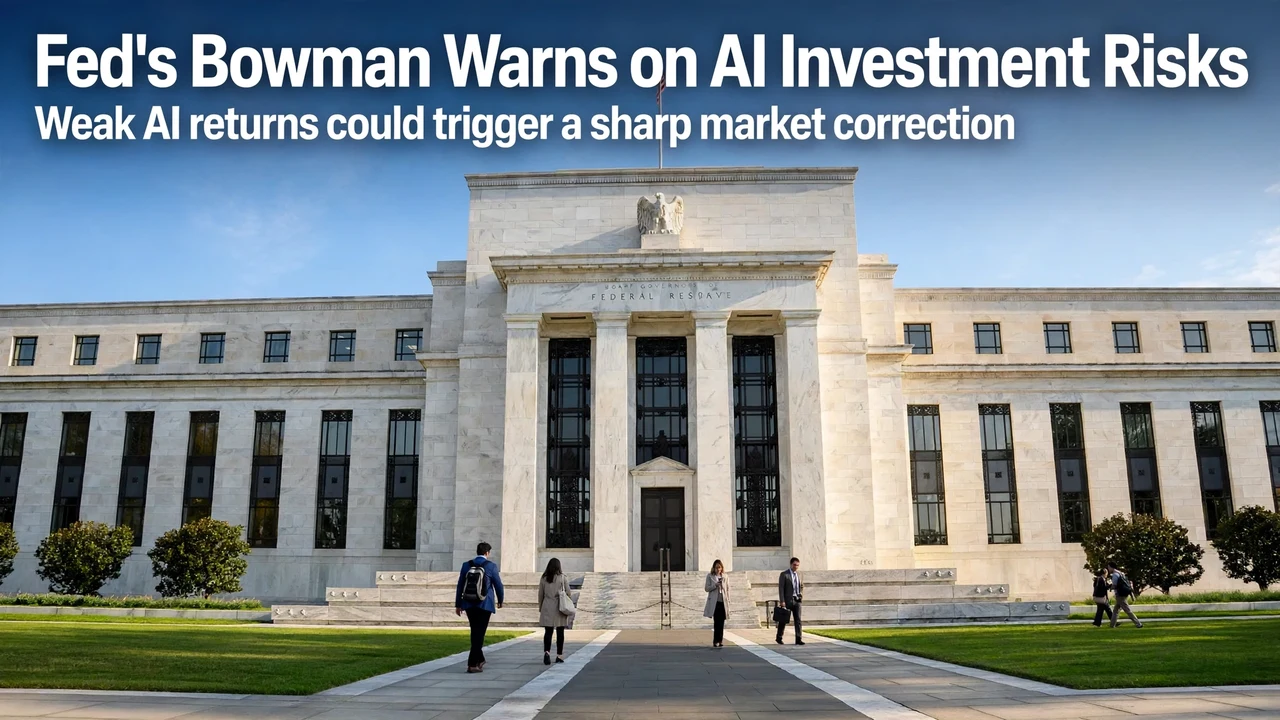
Federal Reserve Vice Chair for Supervision Michelle Bowman said on Nov 10 that equity markets could face a sharp correction if AI investment returns fall short of expectations; AI-related debt is on track to exceed $800 billion this year.
What happened
The Nov 10 speech was delivered at the Council on Foreign Relations in Washington, hours after a hotter-than-forecast October consumer price report. Bowman listed financial-market risks among the main threats to economic activity, including a "large correction in equity valuations" if returns on AI investments fall short of expectations, as well as a sharp rise in private longer-term rates; she said lower equity prices could undermine the resilience of consumer spending.
Bowman put numbers on the AI buildout: AI-related debt, spanning corporate bonds, private credit and project finance, is on track to exceed $800 billion this year, while off-balance-sheet liabilities — long-term leases, contract commitments and residual-value guarantees — carry potential payments estimated at more than three times that amount. She said equity investments by technology suppliers in companies buying their products, along with circular financing, make counterparty risk harder to assess.
Bowman said AI revenues are rising quickly but do not yet cover the cost of maintaining existing models and building new data centers; about 25% of businesses and roughly 10% of workers use AI daily, and business investment growth has reached a pace similar to the 1990s tech boom. If revenue fails to keep up with sharply rising costs, she said, the result could be a sharp correction in AI companies' share prices, higher financing costs and reduced access to credit, slowing the AI buildout and softening economic activity. On monetary policy, she supported the Federal Open Market Committee's October decision to hold the federal funds rate at 3.75% to 4%; October CPI data suggest 12-month core personal consumption expenditures inflation likely rose to 3.3%. She did not call for a December rate increase, saying further tightening must be weighed against its costs for interest-rate-sensitive sectors.
Key facts
- Speech: Nov 10, 2026, Council on Foreign Relations, Washington; Bowman is a Fed governor and Vice Chair for Supervision
- Debt scale: AI-related debt on track to exceed $800 billion this year; off-balance-sheet obligations potentially worth more than three times that
- Risk mechanics: Supplier equity stakes in buyers and circular financing make counterparty risk harder to assess
- Conditional warning: If AI revenue lags costs, share prices could correct sharply, financing costs rise and credit tighten, slowing the AI buildout
- Monetary policy: Backed holding rates at 3.75% to 4% in October; October core PCE inflation likely rose to 3.3%; no call for a December hike
Why it matters
the Fed's top supervision official put AI debt and circular financing on the list of main economic risks, citing $800 billion in debt and off-balance-sheet exposure of more than three times that.
Follow HIMIAO Horizon
No sign-up · Unsubscribe any timeNotifications
A ping on your phone or computer when the brief is out. No email needed.
Comments
Today
Nov 12 Thursday- Brief
- GitHubGitHub Weekly Vol.5: 6 Projects Worth a Look This Week
Tested or read — weeklyAll →
- Quiz
- Call
Latest news
All →- Nov 12United Airlines Bans AI Agents From Booking Flights
- Nov 12ByteDance Readies Muse-Like AI Assistant; Zhang Sees Frontier Catch-Up by 2029 at Earliest
- Nov 12Baidu Launches ERNIE 5.5 Flash Preview, Weights Open by Nov 25
- Nov 12Anthropic Says AI-Driven R&D Acceleration Has Met Its Safety-Policy Threshold
- Nov 12Anthropic Adds About $10B in Cloud Commitments; Google, Microsoft Named Strategic IPO Investors
- Nov 12Kimi K3.1 Pro vs Qwen3.8-Max: Same $2 Input, $4 Apart on Output