 ™
TopicNew York City AI hearings and bills
New York City Bans Algorithmic Surveillance Pricing in 44-5 Vote
The New York City Council voted 44-5 on Nov 12 to pass Introduction 891-A, barring businesses from using algorithms and personal data to charge different customers different prices; the bill is now with the mayor and takes effect one year after becoming law.
What happened
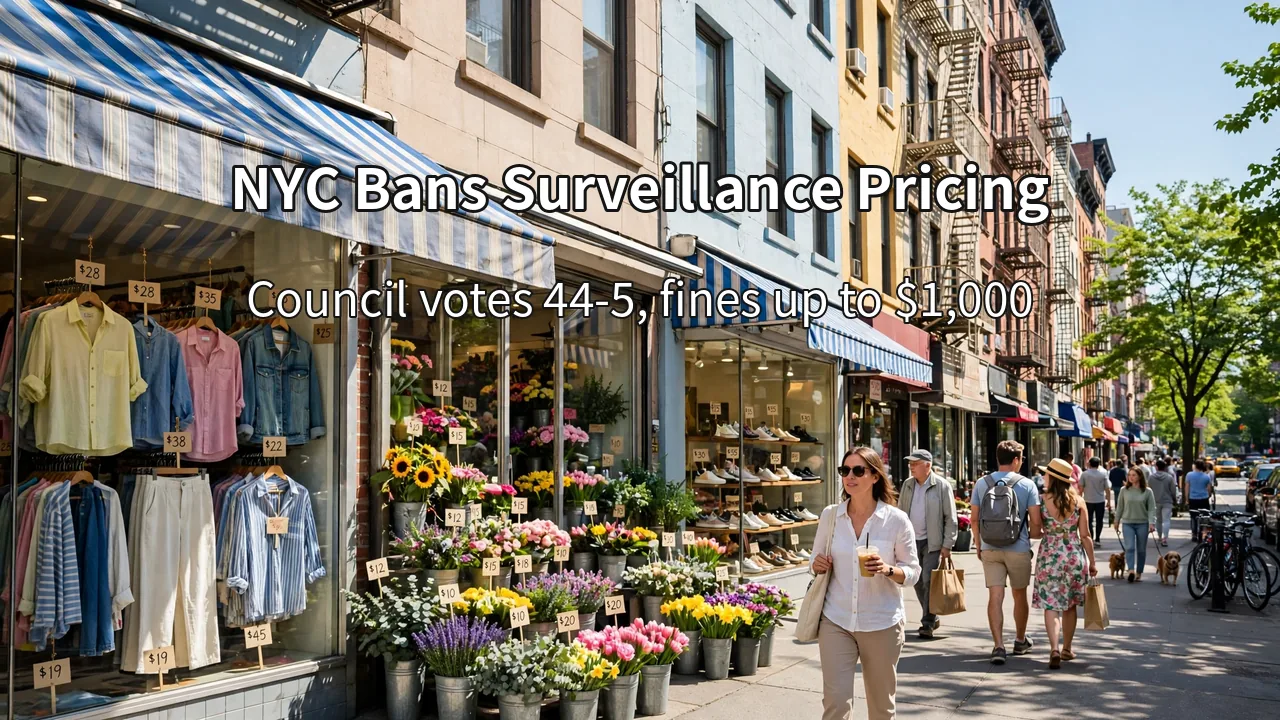
On Nov 12, the New York City Council voted 44-5 to pass Introduction 891-A, sponsored by Speaker Julie Menin, banning "surveillance pricing": businesses may not use algorithms and personal data to charge different customers different prices for the same goods or services, while bona fide custom discounts are excluded. The Committee on Consumer and Worker Protection approved the bill 10-0 the same day.
The bill also restricts collecting, using, selling, retaining or sharing personal data to facilitate surveillance pricing. The city's Department of Consumer and Worker Protection enforces it, with civil fines of up to $1,000 per violation, counted per affected consumer or transaction. The law takes effect one year after it becomes law.
Mayor Mamdani has said he supports the bill. New York becomes the fifth U.S. jurisdiction to ban surveillance pricing; the state Legislature passed its own version, the One Fair Price Act, in June, and that bill is awaiting Governor Kathy Hochul's signature.
Key facts
- Vote: The Council passed Introduction 891-A 44-5 on Nov 12; the Committee on Consumer and Worker Protection approved it 10-0 the same day
- Sponsor: Council Speaker Julie Menin
- What is banned: Prices set wholly or partly by an algorithm using personal data to charge different customers different amounts; bona fide custom discounts are excluded
- Data limits: Collecting, using, selling, retaining or sharing personal data to facilitate surveillance pricing is also restricted
- Penalties: Civil fines of up to $1,000 per violation, counted per affected consumer or transaction; enforced by the Department of Consumer and Worker Protection
- Timing: The law takes effect one year after it becomes law; it is now with the mayor for signature, and the mayor has said he supports it
- Scope: New York becomes the fifth U.S. jurisdiction to ban surveillance pricing; the state Legislature's One Fair Price Act, passed in June, still awaits the governor's signature
Why it matters
New York becomes the fifth U.S. jurisdiction to ban surveillance pricing, while the state legislature's version from June still awaits the governor's signature.
Follow HIMIAO Horizon
No sign-up · Unsubscribe any timeNotifications
A ping on your phone or computer when the brief is out. No email needed.
Comments
Related
- Nov 11New York Opens RAISE Act Registration for Frontier Developers Over $500M
- Nov 8US Cleared Shell Firms to Handle Restricted H200 Chips, NYT Finds
- Nov 3NYT Sues Brave Over AI Scraping of Its Content
- Oct 31Wikimedia Foundation Weighs In on NYT v. OpenAI: Split Training From Chatbot Answers
- Oct 30New York Signs AI Companion Law Restricting Chatbot Features for Minors, Effective January 2027
Today
Nov 17 Tuesday- Brief
- GitHubGitHub Weekly Vol.6: 7 Projects Worth a Look This Week
Tested or read — weeklyAll →
- Quiz
- Call
Latest news
All →- Nov 17US Commerce Department Closes "Cloud Loophole" for Advanced AI Chips
- Nov 17OpenAI Launches Science Blog as GPT-6 Astra Leads Proof of Candidate Lattice Standard Model Definition
- Nov 17Apple Smart Glasses Said to Debut at WWDC 2027 With No Display, Leaning on Siri and iPhone
- Nov 17AI Labs Race to Hire Counterintelligence Staff: Anthropic 33 This Year, OpenAI 22
- Nov 17Trump Backs Huang's Return to Nvidia: 'He Learned a Big Lesson'
- Nov 16Kuo: OpenAI and Anthropic to Buy About 26M Google TPUs in 2028–29