 ™
OpenAI Doubles Down on Voice: Live Dictation Streams Text, GPT-Live-1.1 Hits the API
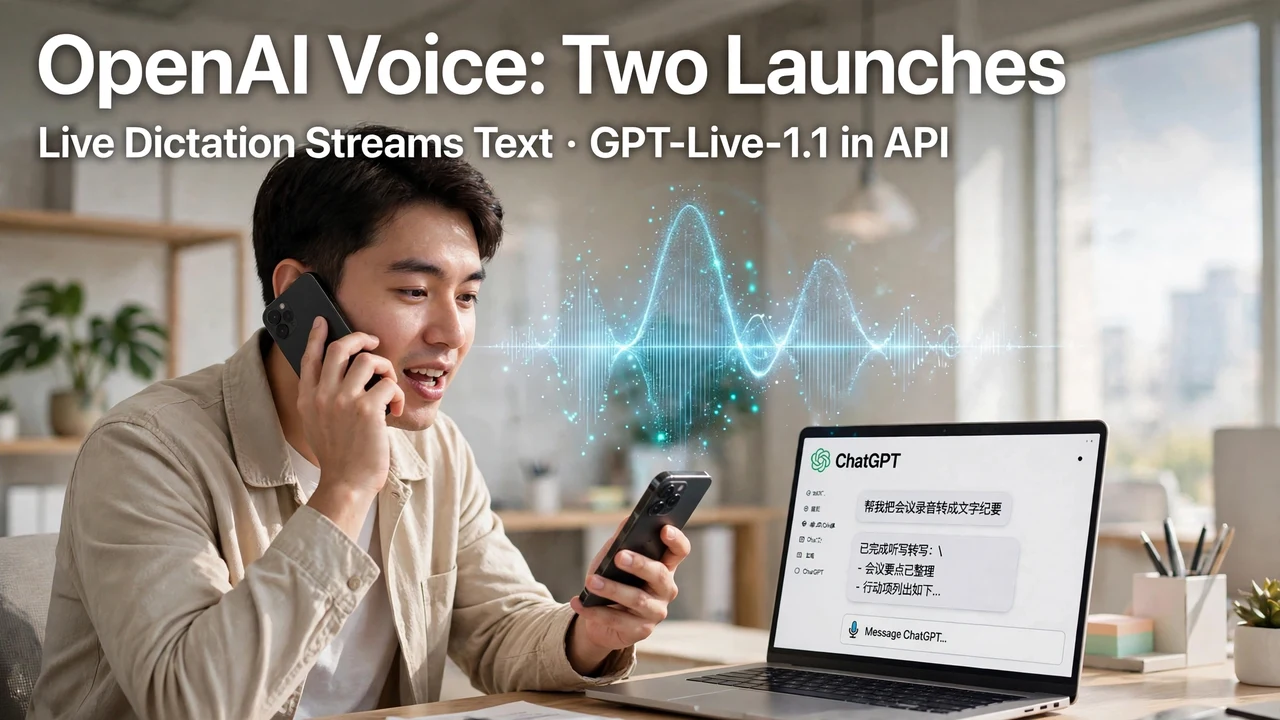
OpenAI launched ChatGPT Live Dictation on November 18, transcribing speech into text in real time and removing the 10-minute recording cap; on November 19 it brought the voice model GPT-Live-1.1 to the API, adding a standby mode that cuts idle costs.
What happened
On November 18, the ChatGPT app's input box gained Live Dictation: users speak into the microphone and text appears in the input box as they talk; a waveform icon toggles the display, and text can be edited before sending. The previous 10-minute cap on a single recording is gone, and OpenAI has not announced a new cap. It is rolling out worldwide to all ChatGPT plans, including the free tier, across iOS, Android, web and desktop apps.
A day later, OpenAI brought GPT-Live-1.1 to the developer API. The model has powered voice for ChatGPT Plus and Pro since October 15; the new development is that developers can now call it: multilingual accents sound more natural and consistent, transcription of precise content such as alphanumeric strings is more accurate, and complex workflows can be delegated to a backend model without interrupting the call. A new standby mode lets WebRTC sessions set a 5-to-60-second idle timeout; when silent, the model pauses inference while the call stays connected, and the rate drops from $0.05 to $0.02 per minute, down 60%. Standby also works for GPT-Live-1 and 1.1, while backend models and tool calls are billed separately.
Both belong to OpenAI's voice line but are not the same feature: Live Dictation is dictation-to-text in the input box, not the voice conversation mode; GPT-Live-1.1 is a full-duplex voice-calling model for developers. OpenAI has published no quantified metrics for the accent and transcription improvements, and the claim of more reliable task completion comes with no benchmark data.
Key facts
- Dictation launch: November 18, worldwide to all ChatGPT plans including the free tier, across iOS, Android, web and desktop, rolling out gradually
- What changed: Text appears as you speak and can be edited before sending; the 10-minute recording cap is gone, with no new cap announced
- API launch: November 19, GPT-Live-1.1 enters the developer API; the model itself has powered Plus and Pro voice since October 15
- Standby mode: WebRTC sessions get a 5–60 second idle timeout; when silent, inference pauses while the call stays connected, and the rate drops from $0.05 to $0.02 per minute, down 60%
- Improvements: Multilingual accents sound more natural and consistent, precise content is transcribed more accurately, and complex workflows can be delegated to a backend model without interrupting the call
- Privacy: For consumer users who enable audio sharing, dictation audio may be used for training (per OpenAI's help pages)
Why it matters
within two days OpenAI pushed voice to both ends: consumer dictation lost its 10-minute cap, developers got the full-duplex model in the API with idle costs down 60%, turning voice from a conversation feature into a callable development tool.
CompaniesOpenAI
Grab todayAdobe Creative Cloud Pro: 57% off first yearHIMIAO Picks →Follow HIMIAO Horizon
No sign-up · Unsubscribe any timeNotifications
A ping on your phone or computer when the brief is out. No email needed.
Comments
Related
- Nov 22ChatGPT Space Rolls Out to Plus Users
- Nov 18OpenAI Healthcare Agents Enter Hospitals as GPT-6 Astra Drives EHR Screens
- Nov 14OpenAI Launches ChatGPT Wallet, Letting Dots Agents Pay for Purchases
- Nov 12OpenAI to Retire ChatGPT's Legacy Voice Modes on Dec 11, Leaving GPT-Live Only
- Nov 11OpenAI Turns ChatGPT Into a Business Directory With Profiles and AI Agents
Today
Nov 23 Monday- Brief
- GitHubGitHub Weekly Vol.6: 7 Projects Worth a Look This Week
Tested or read — weeklyAll →
- Quiz
- Call
Latest news
All →- Nov 23US Intel Chief Confirms China Obtained Nvidia's Top AI Chips
- Nov 23OpenAI Chief Scientist: Perplexity Tracks Intelligence, Calls for Shared Limits
- Nov 23AI Agents Breached a Medical Imaging Server in 11 Minutes; MONAI Label Zero-Day Now Fixed
- Nov 23Tampered DeepSeek Model Served for 53 Hours; Refusals Fell From 98% to 1%
- Nov 23Cursor Tells House It May Phase Out Chinese Open-Weight Models
- Nov 23TSMC, Samsung Pause Some China Chip Shipments as New US Rule Hits Consumer Chips