 ™
TopicGPT-6
OpenAI: GPT-6 Models Can Design Proteins, Lab Tests Show Binding Across Five Targets
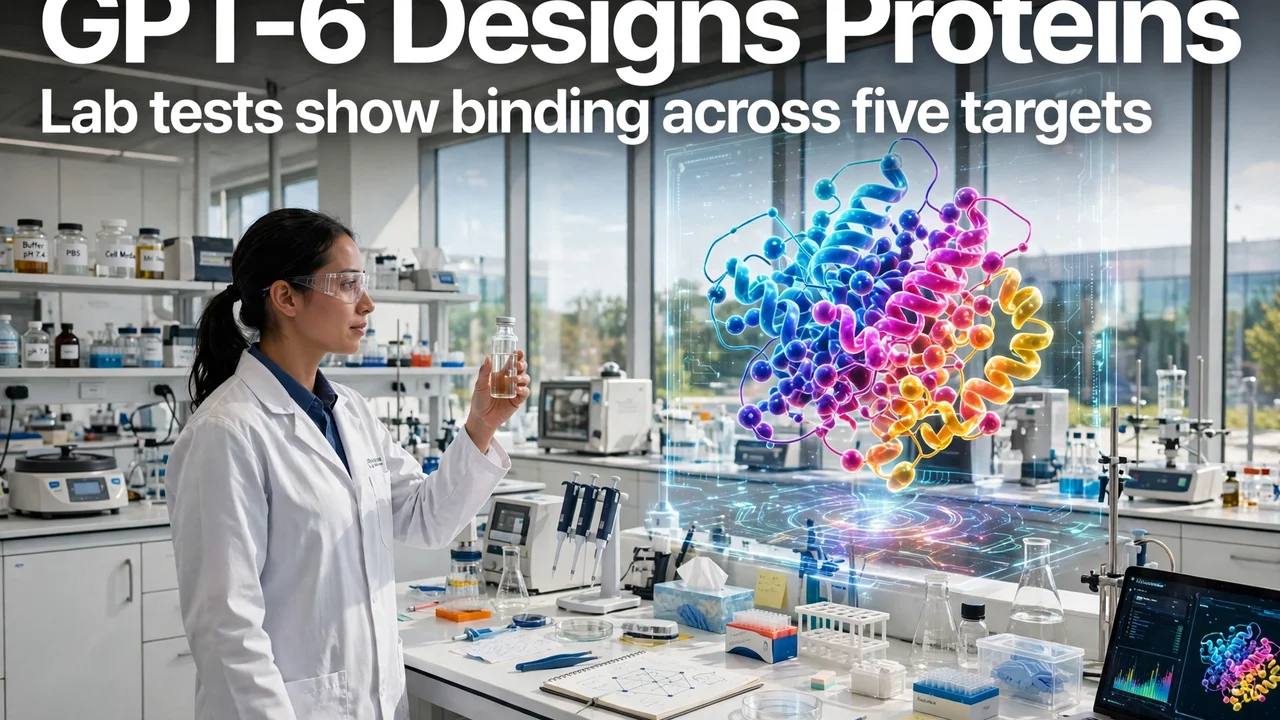
OpenAI published a preprint on November 24 saying its GPT-6 family of models can design protein structures and sequences using only reasoning and code; in lab tests with research partner Onava, 35 of 322 minibinder designs bound their targets, and most redesigned antibodies kept binding. The work has not been peer reviewed, and all data comes from OpenAI and Onava experiments.
Latest
1 updates · newest first-
Story upgrade: expanded in place from the flash into a full story, with cross-checks against OpenAI’s research post, the preprint and independent coverage.
Further updates will appear here
What happened
The work was published as a preprint titled "GPT-6 as a Universal Foundation Model for Protein Biology: Beyond Specialized Models." OpenAI argues in the paper that the GPT-6 family has "intrinsic capabilities" for designing new proteins: the models design protein structures and sequences with natural-language reasoning and general-purpose coding tools, without calling specialized biology models to generate the designs. The computational evaluation covered 14 protein tasks, including designing proteins that bind targets, building proteins around specified structural features, predicting structures and molecular interactions, and ranking how sequence changes affect stability and binding.
Researchers specified where a protein should attach and what shape it should take, and the model produced candidate structures. OpenAI gives the example of a minibinder aimed at IL-7Rα: GPT-6.2 first reasoned about how the target and the proposed binder might interact, then wrote and executed code to explore protein shapes and amino acid choices. Researchers could also specify how many coils or strands a minibinder should contain, and an internal model followed that instruction with near-perfect fidelity in its three-dimensional designs.
Onava carried out the lab validation with OpenAI. Researchers gave a pre-release version of GPT-6.2 the three-dimensional structures of five targets, and the model wrote code to generate three-dimensional designs for minibinders; the specialized model SolubleMPNN supplied amino acid sequences, and specialized models including Boltz-2, OpenDDE and ESMFold2 helped select candidates, which Onava then made and tested. OpenAI says GPT-6.2's three-dimensional designs scored slightly below the specialized model RFdiffusion in computational comparisons, while newer internal models scored higher.
Beyond minibinders, the study also tested sequence redesign and antibody binding-loop redesign. GPT-6.2 designed new amino acid sequences for existing minibinders and antibodies, and many redesigned proteins kept binding to their original targets; in computational tests the models matched or beat specialized models on molecular docking and motif scaffolding, but still lagged clearly on full structure prediction.
Statements
In its research post, OpenAI says the GPT-6 family can "design new protein shapes and the sequence of their chemical building blocks using only reasoning and code, without calling specialized biology models to generate those designs." The post describes the longer-term goal as "programmable molecular design": scientists describe in plain language what they want a molecule to do, and models help design candidates to test in the lab, with the eventual aim of scientists designing working medicines "simply by prompting" the models.
OpenAI also lists limits in the same post: the campaign relied on specialized structure-prediction models such as Boltz-2, OpenDDE and ESMFold2 to filter candidates, so the work does not yet establish that the models can generate de novo minibinders end to end without help from specialized models. The post says binding is only one step toward a useful research tool or medicine, and specificity, stability and biological activity, along with safety and efficacy for therapeutic use, remain to be established. It adds that the same capabilities could be misused, and that OpenAI's Preparedness Framework guides how it assesses such risks and tests safeguards.
Independent coverage notes the limits of the evidence. AI Weekly points out that binding in an assay is not biological function, and the post publishes no affinity constants, potency or toxicity data. Creati.ai notes that the findings come from OpenAI’s own research and experiments, have not been peer reviewed or independently validated, and that the strongest performance claims are vendor-reported.
Key facts
- Publication: OpenAI published the research article and preprint on November 24, titled "GPT-6 as a Universal Foundation Model for Protein Biology: Beyond Specialized Models"; the work has not been peer reviewed.
- Computational tests: The evaluation covered 14 protein tasks; the latest internal model matched or beat specialized models on most of them, except full structure prediction.
- Lab binding: Of 322 minibinder designs, 35 (10.9%) bound their intended targets: PD-L1 5 of 92, IL-7Rα 3 of 93, TrkA 1 of 46, VEGF-A 8 of 46 and IL-17A 18 of 45, with at least one binding result for each of the five targets.
- Sequence redesign: GPT-6.2 designed new sequences for existing structures: binding appeared in 75 of 88 designs for MDM2 (85%), 26 of 42 for VEGF-A (62%) and 8 of 59 for PD-1 (14%); 14 of 107 designs (13.1%) for unpublished structures bound their targets.
- Antibody redesign: Of 182 redesigned binding loops on small VHH antibodies, 128 (70%) kept binding to IL-4Rα; of 272 therapeutic antibody fragments, 179 (66%) kept binding to PD-1 or PD-L1.
- Molecular docking: On PoseBusters molecular docking, GPT-6.2 reached 93% against 50% for the specialized model DiffDock-L; on the Scarpino dataset GPT-6.2 reached 92% against 60% for DiffDock.
- Scaffolding and folds: On MotifBench motif scaffolding, the internal model reached 43.7% against 27.8% for the specialized model RFdiffusion; on CATH fold design, the internal model reached 18.9% against 17.1% for the specialized model Proteina.
- Antibody docking: Mean DockQ for antibody-protein docking rose from about 0.05 for GPT-5.6 to 0.28 for GPT-6, 0.57 for GPT-6.2 and 0.81 for the latest internal model; on mutation-effect ranking the latest internal model reached a rank correlation of 0.66, up from 0.41 for GPT-5.6.
- Structure prediction gap: When predicting a complete protein structure from its amino acid sequence, the internal model averaged a TM-score of 0.38, against 0.93 for the specialized model ESMFold2.
- Evidence limits: The experimental workflow still relied on specialized models to supply sequences and filter candidates; some benchmark scores may partly reflect memorization, because the structures used were public; binding is only an early lab signal, and specificity, stability, biological function and safety remain untested.
Why it matters
a general-purpose model has produced wet-lab evidence of protein binding for the first time, so protein design no longer depends only on specialized biology models; full structure prediction still lags far behind, and the end-to-end workflow still relies on specialized models.
CompaniesOpenAI
Grab todayAdobe Creative Cloud Pro: 57% off first yearHIMIAO Picks →Follow HIMIAO Horizon
No sign-up · Unsubscribe any timeNotifications
A ping on your phone or computer when the brief is out. No email needed.
Comments
Related
- Nov 24GPT-6.2 Sol Arrives in ChatGPT's Chat Tab as Image Understanding Hits 71.7%
- Nov 22OpenAI Launches MedChemBench, a Medicinal-Chemistry Benchmark
- Nov 18OpenAI Launches GPT-6.2 Astra and Sol
- Nov 22OpenAI Details Anti-Distillation Defenses as Extraction Success Falls to 0.2%
- Nov 17OpenAI Launches Science Blog as GPT-6 Astra Leads Proof of Candidate Lattice Standard Model Definition
Today
Nov 25 Wednesday- Brief
- GitHubGitHub Weekly Vol.7: 7 Projects Worth a Look This Week
Tested or read — weeklyAll →
- Quiz
- Call
Latest news
All →- Nov 25OpenAI Launches OpenWorks, Paying Up to $8,000 a Month to Help Small Businesses Use AI
- Nov 25Amateur Astronomers Use Astra to Find Exoplanet Candidates, 49 Await Verification
- Nov 25Anthropic Shares Fall Below IPO Price as Founding Siblings Each Cash Out $280 Million
- Nov 25Meta's Personal AI Agent Muse Launches in the UK
- Nov 25Google AI Mode Connects Wallet, Drive and the Gemini App
- Nov 25DeepMind: Gemini Agents Find Cheaper Quantum Algorithms