 ™
FCC Authorizes SpaceX to Deploy 1 Million Data-Center Satellites
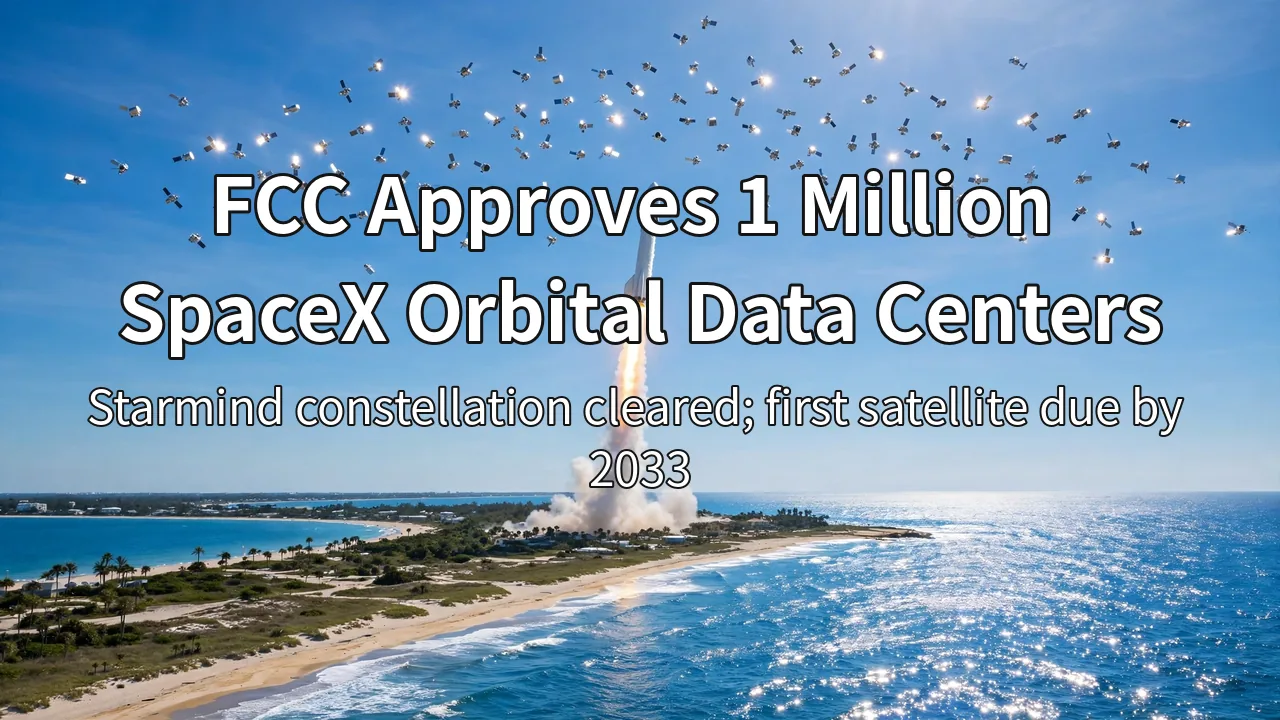
The US Federal Communications Commission on Nov 25 authorized SpaceX to deploy up to 1 million Starmind satellites to process AI workloads in orbit, the first US approval of an orbital data-center constellation; the first satellite is due by 2033, the full constellation by 2040.
Latest
1 updates · newest first-
Upgraded to a story: this flash was expanded in place into a full story, adding approval details, reactions and a comparison with rival orbital data-center plans
Further updates will appear here
What happened
FCC Chair Brendan Carr announced the decision on X on Nov 25, saying the action "opens a bold new frontier for the computing infrastructure needed to power America's leadership and growth." Musk replied on X to thank him, writing: "Much appreciate. This will be a great asset to America and the world."
SpaceX filed its application on January 30, around the time the company completed its acquisition of xAI, bringing Musk's space and AI businesses under one roof. The filing said Starmind would use near-constant sunlight in space to run AI compute for Earth at lower cost and energy use; approval came less than 10 months after the filing.
The approval carries a firm timetable and a 15-year term that starts once the first Starmind satellite reaches orbit: the first operational satellite must launch by November 25, 2033, 10% of the constellation (100,000 satellites) by November 25, 2035, 50% by November 25, 2038, and the full one million by November 25, 2040.
SpaceX said in its filing that Starmind satellites will fly in six orbital shells between 500 and 1,002 kilometres, each carrying a compute payload averaging 175 kilowatts and up to 250 kilowatts, with deployable liquid radiators and solar arrays based on the Starlink design. The satellites will link to each other mainly by optical links and can join the Starlink network; the FCC also authorized radio-frequency links as backup and for emergency telemetry, tracking and command.
Reactions
In its order, the FCC said many objections concerned whether orbital data centers are feasible and what their long-term impact would be, questions outside the agency's regulatory mandate. "In many cases, the comments seek to substitute the government's judgment regarding the viability of business endeavors for that of the applicant and private enterprise. We decline to do so," the order said.
Amazon filed a petition with the FCC in March asking it to reject the application, saying it lacked basic details on satellite design and timing and calling it a "lofty ambition rather than a real plan," while also saying the proposal "risks real harm." Amazon is building a satellite broadband service to compete with Starlink.
Satellite operator Viasat and the American Astronomical Society also objected, citing orbital debris, radio-frequency interference and night-sky brightness; the Secure World Foundation and other groups called for system-level analysis and disclosure and a phased, demonstration-based authorization approach, calling the constellations a "qualitative shift" in the scale of satellite constellations. The FCC received about 1,500 public comments on the application.
Astronomers' concerns did not end with the approval. Astrophysicist Jonathan McDowell, who tracks satellite launches, told CNET the scale of the FCC's approval was unprecedented; astrophysicist Adam Becker warned in an email to CNBC that deployment at this volume risks a cascading chain reaction of orbital collisions that could leave low Earth orbit unusable.
SpaceX President and COO Gwynne Shotwell told investors in October that the company plans to begin launching Starmind satellites in 2027; Chief Financial Officer Bret Johnsen said last week that the first space data centers would launch in 2027 and scale up through 2029. Deploying one million satellites requires the Starship rocket to be operational, the Wall Street Journal reported.
Key facts
- 1 million satellites approved: The FCC on Nov 25 authorized SpaceX's Starmind constellation, with up to 1 million satellites
- A US first: The first approval of a full orbital data-center constellation; SpaceX already has more than 11,000 Starlink satellites in orbit
- First satellite by 2033: The first operational satellite is due by November 2033, the full constellation by 2040
- 500 to 1,002 km orbit: Six orbital shells, each satellite carrying a compute payload averaging 175 kW and up to 250 kW, linked by optical inter-satellite links
- Objectors: Amazon, Viasat and the American Astronomical Society had objected, citing debris and interference
- First launch in 2027: SpaceX plans to launch its first space data centers in 2027 and expand through 2029
- 15-year term: The authorization runs 15 years from the first launch, with several waivers granted
- About 50 times today's fleet: One million satellites would multiply the number of operational satellites in orbit by about 50
The wider race
The FCC said it is reviewing other orbital data-center applications and "intends to issue decisions on each expeditiously." According to the US Government Accountability Office, filings for orbital data centers include SpaceX (1 million satellites), Blue Origin (51,600, Project Sunrise), Starcloud (88,000), Cowboy Space (20,000) and Orbital Inc (100,000).
Google's Project Suncatcher takes a different route: small satellites carrying TPU chips, linked by lasers, flying in a sun-synchronous orbit with near-constant sunlight. The first prototype launched on October 1 aboard a SpaceX rideshare mission, and on October 30 Google said it had run its Gemma 4 model on an orbital TPU and beamed back a haiku.
On November 19, Google and Blue Origin signed a launch services agreement: the first dedicated heavy-lift Suncatcher launch is targeted for the first quarter of 2029 on a New Glenn rocket, with each satellite carrying roughly the computing capacity of a data-center rack. Blue Origin is also the applicant behind Project Sunrise, and the Google agreement gives New Glenn a major future heavy-lift mission.
Open questions
The approval was not unconditional. The FCC did not grant SpaceX's requested waiver to move satellites above 600 kilometres into graveyard orbits at end of life: current rules require satellites to reenter Earth's atmosphere within five years of completing their missions, while SpaceX wants to move some retired satellites into other orbits or even around the sun. The FCC said the company had not provided sufficient information on its disposal plans, and the debris plan remains under review.
The FCC also did not require further review under the National Environmental Policy Act, saying activities in space generally occur outside US territory; on the atmospheric impact of satellites burning up on reentry, it said concerns "remain speculative and not supported in the record." A study published in Earth and Space Chemistry estimated that deploying the constellation could increase chemical pollutants deposited in the upper atmosphere by more than 150 times compared with 2025 levels.
Technical and economic hurdles sit outside the approval: how to cool AI chips in space, how to bring down the cost of manufacturing and launching one million satellites, and how to secure financing for chips destined for orbit. Google's head of data center energy said space data centers could cost up to 100 times as much as those on Earth, The Information reported on November 1. Analysts noted orbital data centers fit SpaceX's long-term vertical integration of compute, satellite operations and launch, but remain technically and economically unproven.
Why it matters
Orbital compute has its first full-constellation regulatory approval, with similar plans from Google and Blue Origin also moving ahead; the one-million scale still needs 14 years to materialize, with debris and astronomy disputes left to later reviews.
CompaniesGoogle
Grab todayAdobe Creative Cloud Pro: 57% off first yearHIMIAO Picks →Follow HIMIAO Horizon
No sign-up · Unsubscribe any timeNotifications
A ping on your phone or computer when the brief is out. No email needed.
Comments
Related
- Nov 18Four Nonprofits Sue Five AI Companies, Seeking a Freeze on Frontier AI Development
- Nov 13Nonprofits Sue Five AI Giants, Seeking a Halt to Frontier Model Development
- Nov 15SemiAnalysis Names Nvidia's Seven Biggest GPU Customers; Six Build Their Own Chips
- Nov 24Virginia and Oregon Sue SpaceX Over Grok's Sexual Images, Including of Apparent Minors
- Nov 20NYC, LA and Chicago Schools Weigh Dropping Google Search
Today
Nov 28 Saturday- BriefNVIDIA Opens Image Model Weights: 30B Parameters, 3B Active per Token
10 stories · Nov 27
- GitHubGitHub Weekly Vol.7: 7 Projects Worth a Look This Week
Tested or read — weeklyAll →
- Quiz
- Call
Latest news
All →- Nov 27Sand.ai Launches MAGI-2: 30-Second 1080p Video With Synced Sound
- Nov 27Photonic Chips Run AI: Q.ANT Pilots in IONOS Data Centers
- Nov 27NVIDIA Opens Image Model Weights: 30B Parameters, 3B Active per Token
- Nov 27Meta Declines Joint FCA Test of Muse
- Nov 27Probe Says Novita, StreamLake Route Requests to ByteDance's Ark
- Nov 27Ant Releases Ling-3.2-air Weights: 124B Parameters Under MIT License