 ™
US Government, Meta and Google Join Biohub's $1.8B Open Dataset Effort for Biology AI
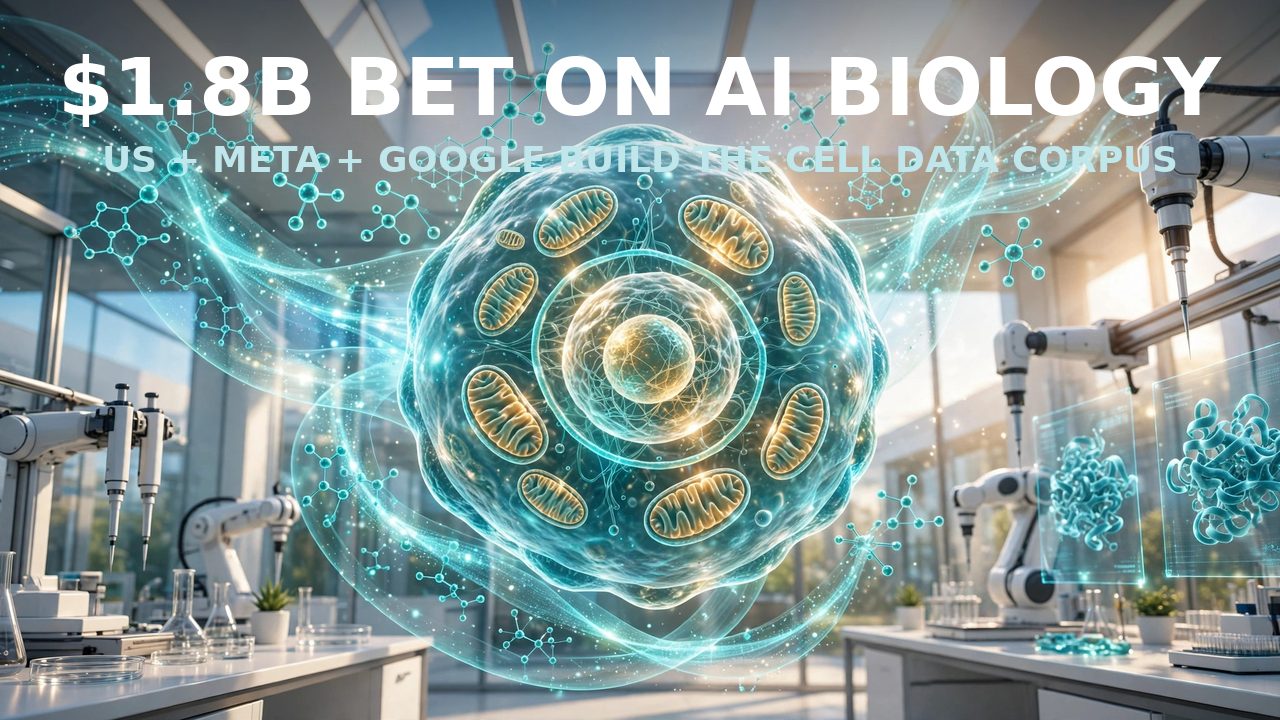
Reuters first reported on October 7 (ET), with Biohub announcing on Wednesday: the US government, Meta and Google parent Alphabet are joining the nonprofit Biohub — Mark Zuckerberg and Priscilla Chan’s philanthropic venture — to build open datasets for training biological AI models, totaling $1.8 billion. Meta, Google DeepMind and drug-discovery startup Isomorphic Labs are jointly investing $300 million; the Department of Energy will invest more than $500 million over five years; the National Institutes of Health (NIH) is handing over datasets and repositories built with more than $500 million in earlier federal funding for Biohub to standardize as AI training data; Biohub itself already put in $500 million back in April.
What Happened
The numbers first: Biohub announced this on Wednesday (October 7 ET), first reported by Reuters. The $1.8 billion breaks down as follows: Meta, Google DeepMind and Isomorphic Labs jointly invest $300 million; the Department of Energy (DOE) puts more than $500 million over five years into laboratory measurement, modeling and computation; the National Institutes of Health (NIH) hands over datasets and repositories built with more than $500 million in earlier federal funding, for Biohub to standardize as AI training data; plus the $500 million Biohub itself put in back in April. The $300M corporate investment and the DOE's $500M+ are new commitments; roughly another $1 billion is pre-existing. The $1.8B total combines old and new money.
The money funds the Virtual Biology Initiative: systematically measuring how cells respond to far more combinations of conditions than scientists have studied, then training predictive models that could compress drug-development timelines (currently measured in years). Biohub head of science Alex Rives says today’s cell datasets cover hundreds of millions of cells, while accurate predictive models need billions and eventually trillions — "We need to capture the language of biology, we need to capture the language of the cell. And that doesn’t exist today." The toolkit includes spatial transcriptomics (mapping molecular activity inside intact tissue) and large-scale screens recording how cells respond to environmental changes — much of it "never generated in a coordinated way" before. Rives’ timeline: work that would normally take decades, compressed into five years; first datasets ready in about a year, accurate predictive models within five years.
Key Facts
- Of the $1.8B, about $800M is new commitments: The $300M from Meta / DeepMind / Isomorphic plus the DOE's $500M+ over five years is new; Biohub's own $500M from April and the NIH datasets built with $500M+ in earlier federal funding are pre-existing. The $1.8B is the sum of all four.
- Funding companies get an embargo period: The data will eventually be released publicly, but the companies funding it get an embargo period — they can work on the data before it becomes a public research resource. Rives says this is how Biohub brings private money into "open science." The government-funded parallel work carries no such condition.
- First data in a year, predictive models within five: Rives says this kind of work "would normally take decades." The data has to be produced with new techniques like spatial transcriptomics, "never generated in a coordinated way" before, scaling from hundreds of millions of cells to billions and trillions. Biohub still plans to bring in pharma companies and philanthropies.
- Other AI companies' biology efforts: Anthropic recently expanded into biology (building a wet lab), and the OpenAI Foundation launched a $125M+ grant program specifically for biological and medical AI datasets.
Context
Biohub is the philanthropic organization of Mark Zuckerberg and Priscilla Chan (under the Chan Zuckerberg Initiative). The Virtual Biology Initiative launched on April 29 of this year, when Biohub committed $500 million itself: $100 million for external research institutions doing global data collection, $400 million for internal technology (next-generation imaging, molecular engineering, data infrastructure); the Broad Institute (MIT / Harvard), the Allen Institute, the Arc Institute, the Wellcome Sanger Institute, the Human Cell Atlas, the Human Protein Atlas and NVIDIA were already on board. Today's news expands that April $500M — the US government plus Meta and Google DeepMind join, taking the total to $1.8 billion.
Why it matters
With the DOE, NIH, Meta and Google DeepMind on board, the Virtual Biology Initiative grows from April's $500 million to $1.8 billion; the first datasets are due in about a year, with predictive cell models targeted within five years.
Follow HIMIAO Horizon
No sign-up · Unsubscribe any timeNotifications
A ping on your phone or computer when the brief is out. No email needed.
Comments
Related
- Oct 14UK Parliament AI Safety Hearing: OpenAI and Anthropic Call for Binding Rules as Google and Meta Decline
- Nov 15SemiAnalysis Names Nvidia's Seven Biggest GPU Customers; Six Build Their Own Chips
- Oct 22Goldman Sachs Commits $500 Million to Launch Small Business AI Institute with OpenAI, Google, Anthropic and Meta
- Nov 18Four Nonprofits Sue Five AI Companies, Seeking a Freeze on Frontier AI Development
- Nov 14SGLang Consortium Launches With Nvidia, AMD, Google and Five More
Today
Nov 28 Saturday- BriefNVIDIA Opens Image Model Weights: 30B Parameters, 3B Active per Token
10 stories · Nov 27
- GitHubGitHub Weekly Vol.7: 7 Projects Worth a Look This Week
Tested or read — weeklyAll →
- Quiz
- Call
Latest news
All →- Nov 27Sand.ai Launches MAGI-2: 30-Second 1080p Video With Synced Sound
- Nov 27Photonic Chips Run AI: Q.ANT Pilots in IONOS Data Centers
- Nov 27NVIDIA Opens Image Model Weights: 30B Parameters, 3B Active per Token
- Nov 27Meta Declines Joint FCA Test of Muse
- Nov 27Probe Says Novita, StreamLake Route Requests to ByteDance's Ark
- Nov 27Ant Releases Ling-3.2-air Weights: 124B Parameters Under MIT License