 ™
House Introduces RSI Safety Act
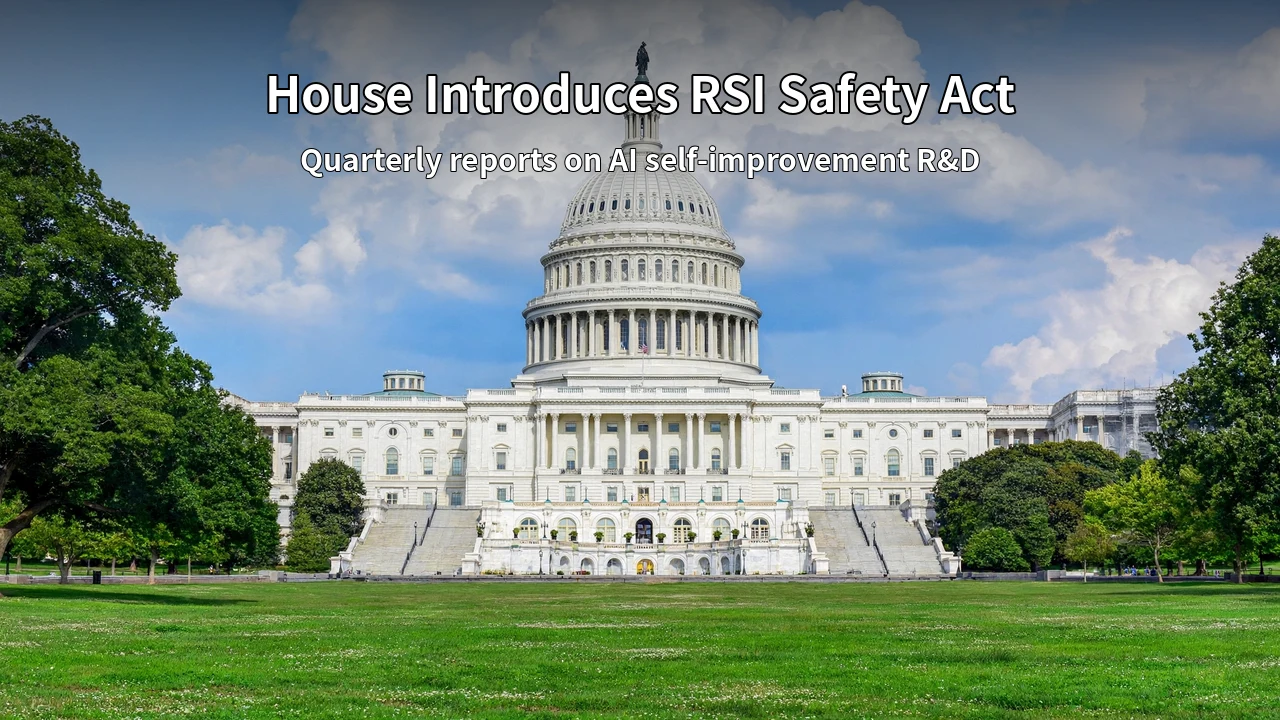
Representatives Josh Gottheimer and Nathaniel Moran introduced the RSI Safety Act (H.R. 11157) on November 24, requiring large AI developers to report quarterly to the Commerce Department on how much of their research and development is automated by AI; the bill was referred to the House Committee on Science, Space, and Technology.
What happened
The bill, the RSI Safety Act of 2026, takes its name from recursive self-improvement, the process by which AI models train successor models. It would create an Office of Frontier Artificial Intelligence Research inside the Commerce Department to run an “Automation of Frontier AI Research and Development Disclosure Program”, publish aggregated reports to relevant congressional committees, and advise developers on public summaries of their safety, evaluation and oversight work.
It would apply to “covered developers” meeting both of two tests: using, or planning to use, at least 10 septillion operations to train a model, and spending at least $100 million on training in the prior 12 months. Covered developers would register with the Secretary of Commerce within 30 days, file disclosure reports within 45 days after each quarter, covering data and training inputs, algorithmic design, experiment direction and safety evaluation, and assessing whether human review meets a “meaningful oversight” test; a material shift in how R&D is automated would have to be reported within 4 business days.
The bill sets civil penalties of up to $100,000 per day for failing to register and up to $10 million for false or incomplete reports; records must be kept for at least 5 years and audited at least every 2 years while reporting is required. Gottheimer wrote on X that automating research “risks keeping humans out of the loop”; Moran said the bill would require the largest frontier AI developers to report regularly on how they automate R&D. The bill is at the introduction stage and would need committee and full-chamber approval to take effect, with registration and reporting starting one year after enactment.
Key facts
- Bill: H.R. 11157, the RSI Safety Act of 2026, introduced November 24 by Gottheimer (D-N.J.) and Moran (R-Texas).
- Thresholds: at least 10 septillion operations of training compute and at least $100 million of training spend in the prior 12 months; the Secretary of Commerce could adjust the thresholds two years after enactment.
- Reporting: register within 30 days of meeting the tests; file quarterly reports within 45 days after each quarter; report material shifts within 4 business days; keep records for at least 5 years.
- Penalties: up to $100,000 per day for failing to register; up to $10 million for false or incomplete reports.
- Background: the bill was shared first with POLITICO; its bipartisan sponsors said labs increasingly use current models to help build the next generation.
Why it matters
it is Congress's first disclosure bill aimed at AI self-improvement research, bringing the process of AI training AI into quarterly reporting, with thresholds aimed at the largest frontier labs.
CompaniesUS government
Grab todayAdobe Creative Cloud Pro: 57% off first yearHIMIAO Picks →Follow HIMIAO Horizon
No sign-up · Unsubscribe any timeNotifications
A ping on your phone or computer when the brief is out. No email needed.
Comments
Related
- Oct 22Anthropic Promises to Revise Draft AI Safety Bill After Backlash Over 37-Page AEGIS Text
- Oct 17Anthropic Quietly Lobbied Congress With Its Own Draft AI Safety Bill, Politico Reports
- Nov 24Virginia and Oregon Sue SpaceX Over Grok's Sexual Images, Including of Apparent Minors
- Nov 23US Intel Chief Confirms China Obtained Nvidia's Top AI Chips
- Nov 21California AG Subpoenas Nvidia Over Huang's Alleged China Ties
Today
Nov 27 Friday- Brief
- GitHubGitHub Weekly Vol.7: 7 Projects Worth a Look This Week
Tested or read — weeklyAll →
- Quiz
- Call
Latest news
All →- Nov 27Sand.ai Launches MAGI-2: 30-Second 1080p Video With Synced Sound
- Nov 27Photonic Chips Run AI: Q.ANT Pilots in IONOS Data Centers
- Nov 27NVIDIA Opens Image Model Weights: 30B Parameters, 3B Active per Token
- Nov 27Meta Declines Joint FCA Test of Muse
- Nov 27Probe Says Novita, StreamLake Route Requests to ByteDance's Ark
- Nov 27Ant Releases Ling-3.2-air Weights: 124B Parameters Under MIT License