 ™
Microsoft Ships Its Own Voice Stack: 60-Language Streaming Transcription + Seconds-Level Voice Cloning
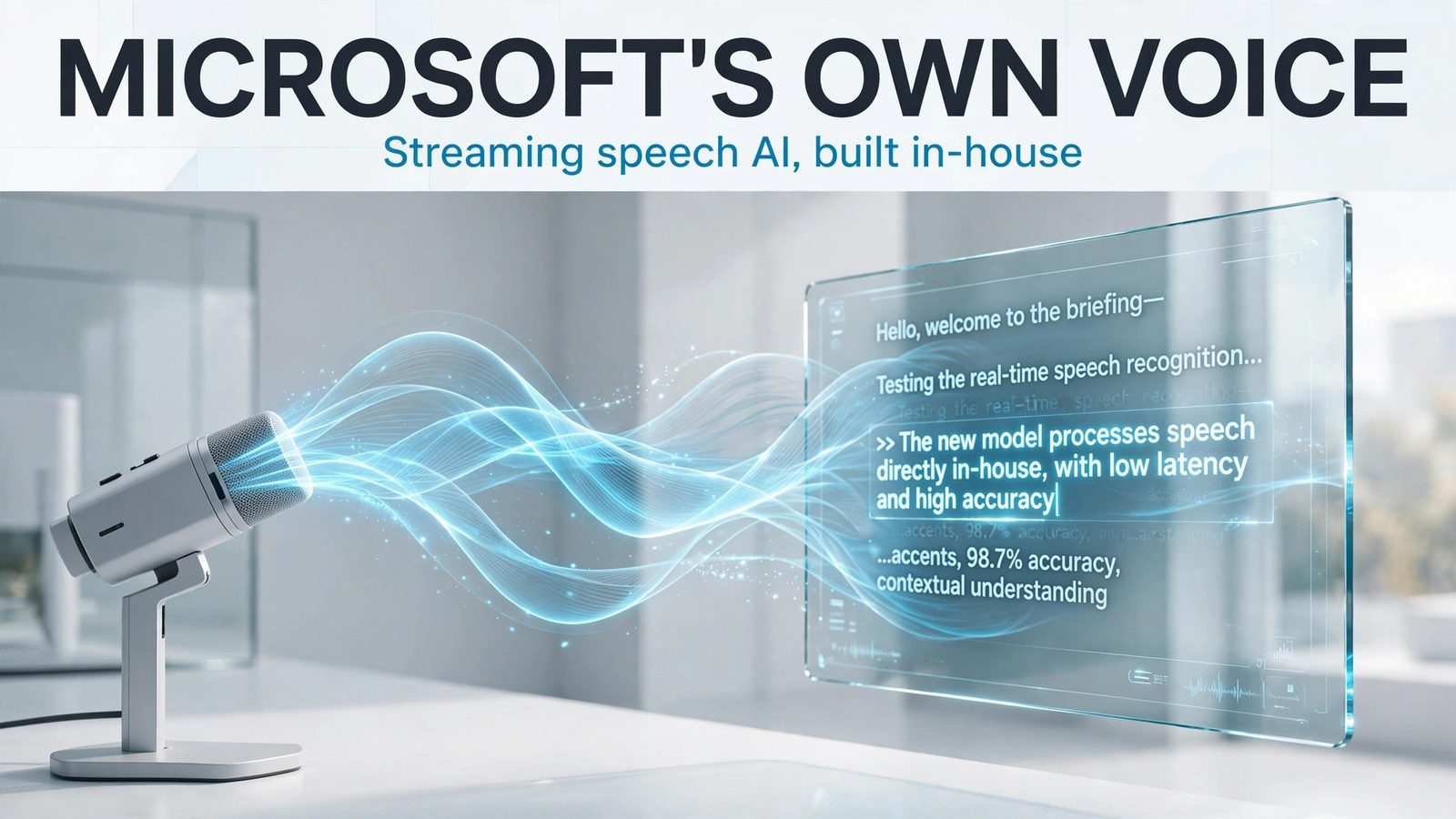
On October 1, the Microsoft AI official blog launched a homegrown voice model stack: streaming transcription model MAI-Transcribe-2-Streaming supports 60 languages with first-word latency of about 100 milliseconds, which Microsoft claims ranks #1 on Artificial Analysis accuracy benchmarks; the simultaneously released MAI-Voice-2.1 and Flash text-to-speech models clone a voice from just seconds of reference audio.
What Happened
On October 1, Microsoft AI unveiled three homegrown voice models on its official blog microsoft.ai: streaming transcription model MAI-Transcribe-2-Streaming, plus two text-to-speech models, MAI-Voice-2.1 and MAI-Voice-Flash, covering both speech recognition and speech synthesis.
The transcription model is all about real time: 60 languages, continuous automatic language detection, ~100ms first-word latency, priced at $0.54 per audio hour (promotional price this year). Microsoft claims it ranks #1 on Artificial Analysis for both final and partial transcription accuracy. On the TTS side, MAI-Voice-2.1 covers 23 languages and 26 regions, with same-speaker cross-language support that keeps local accents ($22 per million characters); the Flash edition pushes latency down to 150ms ($15 per million characters). Voice cloning needs only seconds of reference audio, but requires approval and ships with consent safeguards.
Key Facts
- When & where: October 1, 2026, first published on the Microsoft AI official blog (microsoft.ai); covered consistently by The Decoder, RuntimeWire, TestingCatalog, and WindowsReport.
- Transcription: MAI-Transcribe-2-Streaming: 60 languages, continuous automatic language detection, ~100ms first word; Microsoft claims #1 on Artificial Analysis final/partial transcription accuracy; $0.54/audio hour (promotional price this year).
- Speech synthesis: MAI-Voice-2.1: 23 languages / 26 regions, same-speaker cross-language with local accents, $22 per million characters; Flash edition: 150ms latency, $15 per million characters.
- Voice cloning: Clones a voice from seconds of reference audio; requires approval and includes consent safeguards.
Context
OpenAI had already launched its Realtime API and TTS models. Microsoft's three new models are all built in-house, with no outside models.
Why it matters
All three transcription and speech models are built in-house by Microsoft; transcription has ~100ms first-word latency at $0.54 per audio hour, and the Flash TTS model runs at 150ms latency for $15 per million characters.
CompaniesMicrosoft
Grab todayAdobe Creative Cloud Pro: 57% off first yearHIMIAO Picks →Follow HIMIAO Horizon
No sign-up · Unsubscribe any timeNotifications
A ping on your phone or computer when the brief is out. No email needed.
Comments
Related
- Nov 18Microsoft Unveils Seven MAI Models: Code 2 Matches Claude at 5% of the Price
- Nov 19MAI Code 2 vs Claude Opus 5.5 and GPT-6.1 Sol: $0.50 Input vs $4, Promo Price Until May 2027
- Oct 17Microsoft's MAI-Base-2 Completes Pre-Training: 2T-Parameter All-MoE Architecture, Trained 38 Days on 16,000 GB200s
- Oct 13Microsoft Unveils Maia 300, Its Third Custom AI Chip, With Deployments Possibly Topping One Million Next Year
- Nov 20Microsoft Reportedly Nears $500 Million Azure Deal with ByteDance
Today
Nov 27 Friday- Brief
- GitHubGitHub Weekly Vol.7: 7 Projects Worth a Look This Week
Tested or read — weeklyAll →
- Quiz
- Call
Latest news
All →- Nov 27Sand.ai Launches MAGI-2: 30-Second 1080p Video With Synced Sound
- Nov 27Photonic Chips Run AI: Q.ANT Pilots in IONOS Data Centers
- Nov 27NVIDIA Opens Image Model Weights: 30B Parameters, 3B Active per Token
- Nov 27Meta Declines Joint FCA Test of Muse
- Nov 27Probe Says Novita, StreamLake Route Requests to ByteDance's Ark
- Nov 27Ant Releases Ling-3.2-air Weights: 124B Parameters Under MIT License