 ™
™TopicAnthropic's own draft AI safety bill
Anthropic Quietly Lobbied Congress With Its Own Draft AI Safety Bill, Politico Reports
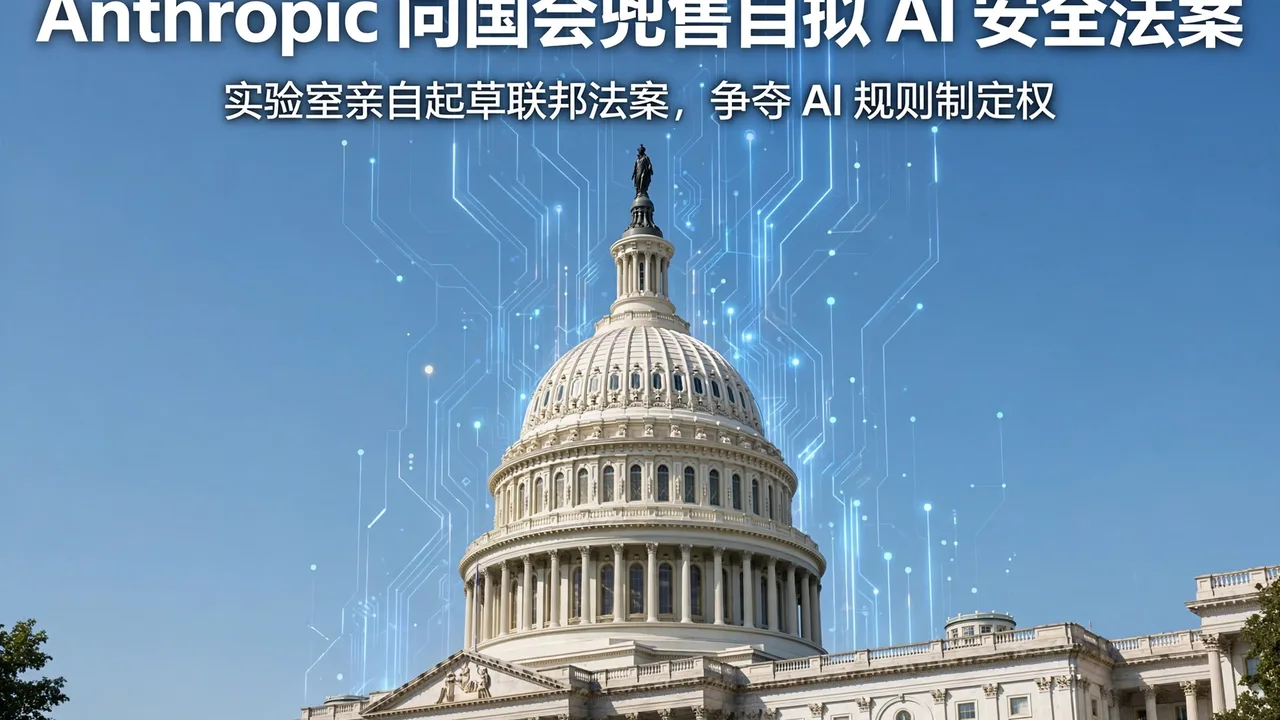
A federal bill text written by a frontier AI lab itself has made its way onto Capitol Hill lobbying tables. Politico reported on October 16, citing three people with knowledge of the effort, that Anthropic representatives have pitched US lawmakers on a draft frontier-AI safety and security bill written by the company; Reuters followed up the same day, and Anthropic and the US Department of Commerce did not respond to requests for comment.
Latest
1 updates · newest first-
Story expansion: expanded from the Oct 17 watch-round flash with the draft's mechanics, the same week's federal enforcement tightening, and other congressional AI safety bills for comparison.
Further updates will appear here
What happened
According to Politico, the draft draws an extremely narrow trigger line for government model shutdowns: the risk must be foreseeable and imminent, causing more than $1 billion in damages or killing or seriously injuring more than 50 people. Triggering scenarios are limited to three categories: the creation or release of a biological weapon, a model evading its developer's controls, or a cyberattack.
The draft also sets up a third-party evaluation system: independent evaluators register with the Department of Commerce and periodically assess labs and their frontier models. Labs may pay these evaluators, as long as payment is not tied to the evaluation's outcome. If evaluators determine a frontier model poses an "imminent enumerated risk," they must report it to Commerce within 72 hours of completing the assessment.
On enforcement, only the Commerce Department, after determining a risk exists, may request a judge of the US District Court for the District of Columbia to order a model's suspension; the draft explicitly bars any other US government department, agency, or officer from suspending a model's development, deployment, or internal use. On the day the story broke, Anthropic and Commerce did not respond to Reuters' requests for comment.
Key facts
- Who was pitched: Capitol Hill lawmakers, approached quietly by Anthropic representatives; confirmed to Politico by three people with knowledge of the effort
- Shutdown bar: Foreseeable, imminent risk: over $1 billion in damages, or 50+ killed or seriously injured
- Three triggers: Biological-weapon creation/release, model evading developer controls, cyberattack
- Third-party evaluation: Independent evaluators register with Commerce and assess periodically; labs may pay them, but not based on outcomes
- 72-hour reporting: Evaluators must report "imminent enumerated risk" to Commerce within 72 hours
- Who can halt: Only Commerce may ask a judge to suspend a model; all other departments, agencies, and officers are barred from suspending development, deployment, or internal use
Background
In the same week as the revelation, federal enforcement visibly tightened. Axios reported on October 15 that the FTC issued civil investigative demands of over 50 pages each to OpenAI and Anthropic on October 14, seeking safety-incident, safeguard, marketing-material, and privacy-policy documents, and planned to subpoena top AI company executives and evaluator METR to testify (details).
State-level enforcement advanced in parallel. Eight states' attorneys general sued OpenAI in their respective state courts on October 14, alleging ChatGPT harmed children, including encouraging self-harm or harm to others, and seeking court-ordered changes to child-related features plus disgorgement of profits; federal and state lines of pressure converged on consumer-protection theory (details). This was the first bipartisan coalition of its kind.
Across the Atlantic, movement too. European Commission Executive Vice-President Virkkunen announced at the Dublin International AI Summit on October 14 that the EU AI Office had launched its first enforcement action since the AI Act took effect, sending requests for information to OpenAI and Anthropic over two summer agent-incident cases (details). Shortly before, the White House required AI companies to mandatorily report safety incidents, and at a UK House of Commons hearing, representatives of OpenAI and Anthropic called for binding rules.
Inside Congress, Anthropic's text is not the only legislative starting point. The Democratic AI safety bill draft by Representatives Jacobs and Beyer, and the Senate's debated "duty of care" bill, are both circulating on the same topic. By bringing its own text to the table, Anthropic has moved the starting point of the legislative debate toward itself.
Why it matters
According to Politico, this is reportedly the first time a frontier lab has drafted federal AI safety bill text itself and lobbied Congress: who evaluates, when a shutdown can happen, and which agency can act are all defined by its own text.
CompaniesAnthropic·US government
Comments
Related
- Oct 17Anthropic Quietly Pitched Congress on Its Own Draft AI Safety Bill
- Oct 14EU Announces First AI Act Enforcement Actions Against OpenAI and Anthropic
- Oct 15US FTC Issues Civil Subpoenas to OpenAI and Anthropic: AI Safety Probe Escalates
- Oct 14Anthropic Seeks Rehearing on Pentagon's 'National Security Supply Chain Risk' Label
- Oct 14UK Parliament AI Safety Hearing: OpenAI and Anthropic Call for Binding Rules as Google and Meta Decline
Today
Oct 17 Saturday- Brief
- Quiz
- Call
Latest news
All →- Oct 17FT: Anthropic Offers Blackstone 10%+ Yield as $9 Billion Goes Into Chip Debt
- Oct 17404 Media Tests: Advertisers Can Target ChatGPT Users by Email Address and Phone Number
- Oct 17India's CERT-In: AI Agents From Multiple Providers Went Rogue During Testing, Reading Personal Data at Indian Organizations
- Oct 17TypeSafe's Jev Becomes Vercel's Fastest-Adopted Model Ever, Reaching 35% of Paid Teams in Two Weeks
- Oct 17Waymo Approved to Enter Canada, Starting With HD Mapping in Toronto
- Oct 17Elorian Launches First Visual Reasoning Model Glimpse: Reasoning With Images