 ™
™TopicTrending open-source AI on GitHub
Stably AI's Orca Tops GitHub Daily Trending: One Desktop App to Orchestrate 30+ Coding Agents
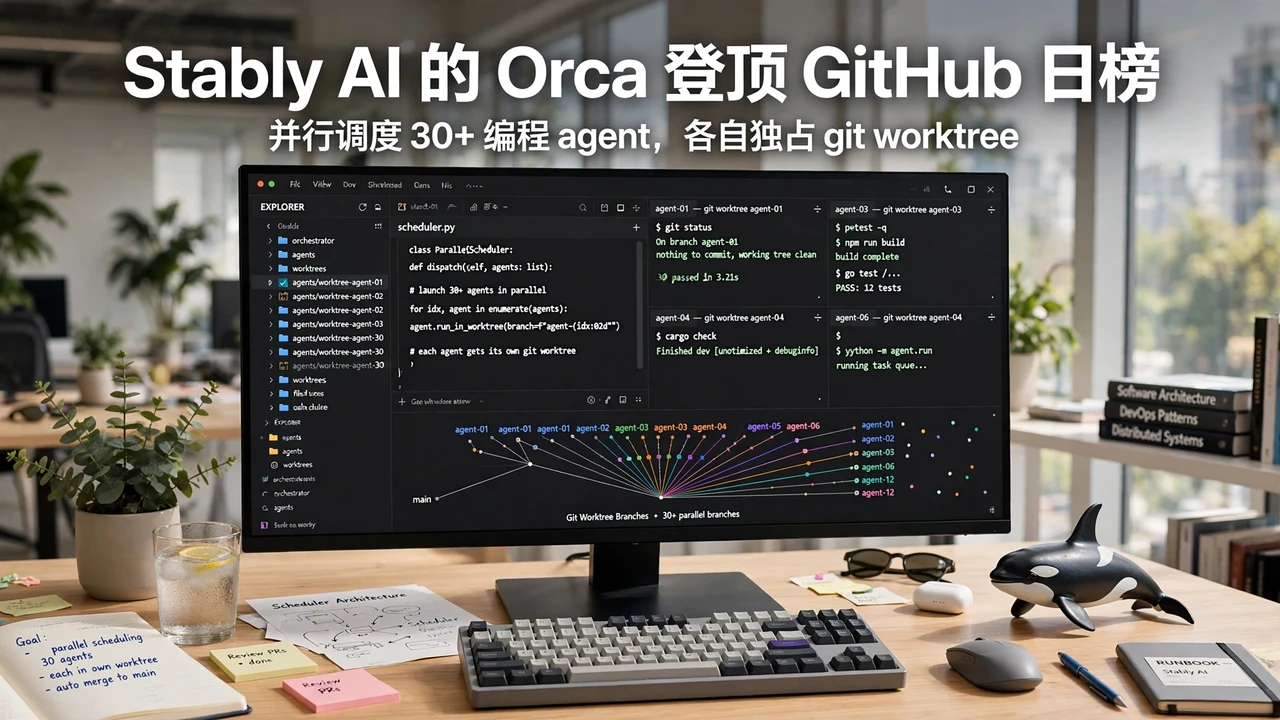
As coding agents multiply, the new bottleneck is how to command them all at once. Stably AI's open-source Orca answers with a desktop app: fan one prompt out to multiple agents — Claude Code, Codex, OpenCode and more — each in its own git worktree so files never collide; compare the results side by side and merge the winner. It ships no model and no agent of its own; it is purely the orchestration layer.
What happened
Orca is built by San Francisco-based Stably AI (Y Combinator W22, founded by Jinjing Liang and Neil Parker); the repository was created on March 17, 2026, under the MIT license. It positions itself as an 'agent development environment': every task gets its own git worktree inside the desktop app, with a terminal, file editor, diff viewer, and built-in browser for GitHub PRs and Linear tickets.
The core mechanism is parallel worktrees: one prompt goes to multiple agents, each running in an isolated worktree so agents stop overwriting each other's files; compare the results side by side and merge the winner. It supports 30+ CLI coding agents (Claude Code, OpenAI Codex, OpenCode, Grok, Gemini, Cursor CLI, GitHub Copilot CLI, and more), billed through the user's own subscriptions and API keys — no per-seat pricing, no middleman markup. Companion features include a mobile app for remote monitoring and steering (push notifications when an agent finishes), SSH remote worktrees, terminal splits, and a scriptable Orca CLI.
Traction: on Oct 18, Orca topped GitHub's daily trending at #1 (also #1 on that day's YouTube 'Top 5 trending dev tools on GitHub' list); a six-week hands-on deep dive on dev.to (around Oct 15) put it as 'not an agent — it orchestrates the agents you already use'; a third-party blog compared it against herdr and Claude Code's built-in worktree flag on Oct 4. The repository now sits at roughly 96K stars (84,769 in a third-party snapshot on Oct 4).
Key facts
The business model is distinctive: Orca sells neither tokens nor seats — it sells 'coordination infrastructure,' with users keeping direct subscriptions with Anthropic, OpenAI, and xAI. The costs are stated plainly too: each worktree duplicates dependencies (disk and memory), and more parallel agents mean bigger token bills and more diffs to review; the dev.to review notes 400–800MB of idle RAM usage and occasional rough edges from the near-daily release cadence.
Maker background: Stably AI is a YC W22 San Francisco company; the repository has shipped nearly a thousand releases since its March creation, on a near-daily cadence. The MIT license is part of why it took off on GitHub — most agent-orchestration tooling in this space had previously been closed-source or subscription-gated.
Why it matters
It isn't an agent — it's the orchestration layer for agents: MIT-licensed, billed through your own subscriptions, fanning one prompt across many agents in parallel. 96K stars is a rare scale for this category of tool.
Comments
Related
- Oct 10AI Agent Diagram Skill diagram-design Returns to GitHub Trending, Reaching 48K Stars
- Oct 15iFixAi Hits GitHub Trending: "Is This AI Agent Doing Its Job?" Answered in 120 Seconds
- Oct 13VoiceStudio Tops GitHub Trending: A Fully Local Open-Source Voice Studio
- Oct 13Vercel's Open-Source Skills Tops GitHub Trending: One Command to Equip AI Coding Assistants
- Oct 13REA Review: Letting Agents Reverse-Engineer Anything, 100K Stars in a Week
Today
Oct 19 Monday- Brief
- GitHubGitHub Weekly Vol.1: 8 Projects Worth Your Time
Tested or read — weeklyAll →
- Quiz
- Call
Latest news
All →- Oct 18Anthropic to Commit 5% of Shares to New Public Benefit Fund
- Oct 19Jailbroken PS5 Becomes a Local AI Server: Qwen3.8-27B Hits ~20 tok/s, Small Models Top 100
- Oct 19Anthropic Internal Study: Junior Share of Technical Staff Falls to 14%, Meeting Time Up 20%
- Oct 18Claude Cracks 25-Year Cryptography Mystery in Half an Hour: NIST Curve Seeds Came From a 1997 Clock
- Oct 18OpenCode Hit by "Distillation Attack": API Keys of About 1.4% of Users Compromised
- Oct 18Websites Are Closing Their Doors to AI Agents: Yelp, Delta, JPMorgan Draw Lines