 ™
Claude Helps Map First 3D Structure of a Bacterial Vault Particle: 96 Protein Copies Form a Hollow Shell
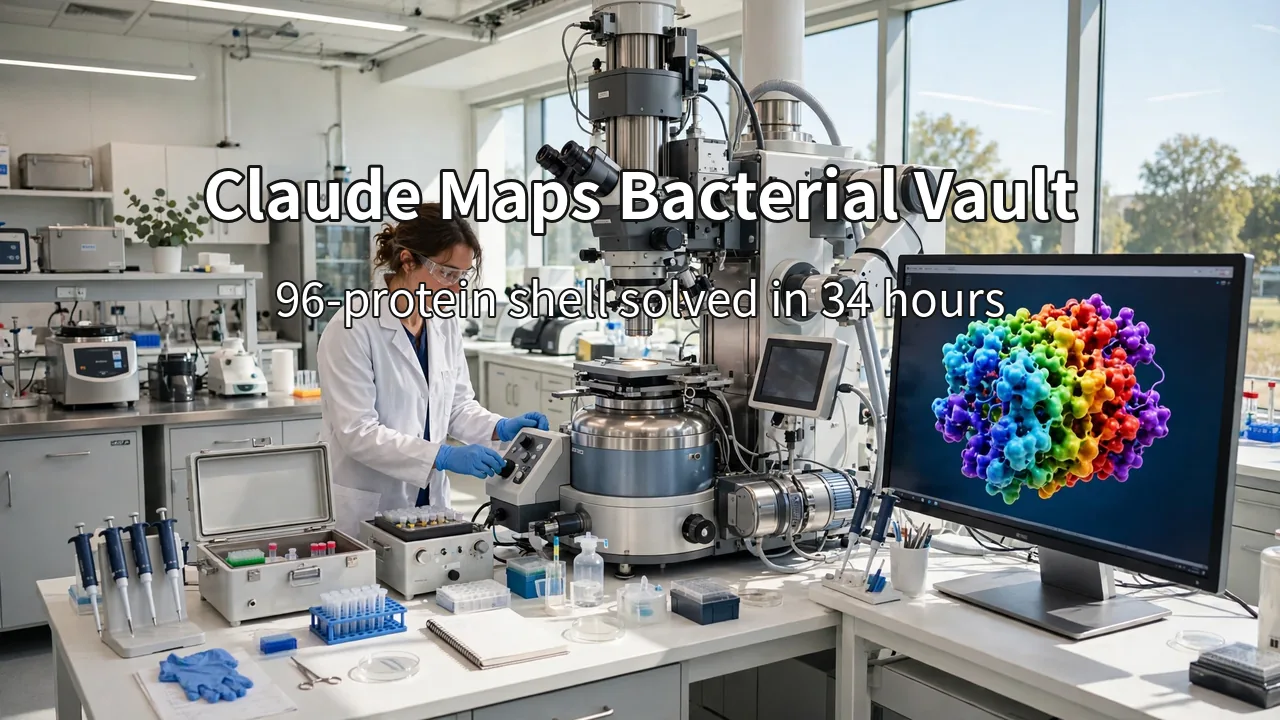
Anthropic said on Nov 4 that its biology research team, working with Claude, mapped the first 3D structure of a vault particle from prokaryotic cells: 96 copies of the bacteriophage protein L05 assemble into a hollow shell inside E. coli.
What happened
The research was published on Nov 4 by Anthropic's biology research team on the company's research blog, "Investigating vault particles with Claude"; the preprint has been submitted to bioRxiv, with the link to follow. Using Claude Science, the team searched about 15 billion predicted proteins for vault protein homologs, found candidates in 29 bacterial phyla and four archaeal phyla, and moved 44 proteins into laboratory validation. Vault particles are hollow protein shells discovered in 1986 by Leonard Rome and Nancy Kedersha, and their function remains unknown.
The validation chain narrowed step by step: 24 candidates went into E. coli expression, 15 produced soluble protein, seven formed vault-like particles under the electron microscope, and cryo-EM confirmed four of them — two from phages and two from bacteria. The phage protein L05 was selected for detailed structural analysis: 96 copies of a single protein form a hollow shell, 48 per half, about 54 nanometers long and 45 wide, with a total mass of about 9.5 megadaltons, at 3.2 angstrom resolution; it is shorter and wider than a human vault and encloses about 25% more volume. The team also engineered a larger vault by duplicating part of the protein sequence.
Claude assisted at each step of the research: searching protein databases, designing DNA constructs, optimizing the isolation method and processing microscopy data. Purification fell from about three days to about 90 minutes, and a first full structural model was ready in 34 hours, which the team estimates would normally take weeks; the final reconstruction took about a week. The mistakes were recorded just as plainly: a growth protocol Claude wrote included an additive that interfered with getting DNA into cells, delaying the project by two weeks; and while processing microscopy data it skipped a standard step, producing an incorrect structural map that combined the particle's image with its mirror image, corrected after human review.
Key facts
- Publisher and date: Anthropic's biology research team, Nov 4, 2026
- Subject: the bacteriophage protein L05, with 96 copies assembling into a hollow vault particle; human vaults have 78 copies
- Size: about 54 nanometers long and 45 wide, total mass about 9.5 megadaltons; 3.2 angstrom resolution
- Volume: shorter and wider than a human vault, enclosing about 25% more volume; seven repeating wall segments per protein chain, against nine in humans
- Screening: about 15 billion predicted proteins; homologs found in 29 bacterial phyla and four archaeal phyla; 44 proteins moved to validation
- Validation chain: 24 moved into E. coli expression, 15 produced soluble protein, seven formed particles, cryo-EM confirmed four
- Speed: purification from about three days to about 90 minutes; the first full model in 34 hours, the final reconstruction in about a week
- Mistakes: an additive Claude suggested interfered with DNA delivery, delaying the project two weeks; a skipped step in microscopy processing produced a mirror-image error
- Open items: the particles were produced only in E. coli, with no confirmation they form in natural hosts or during phage infection; the function remains unknown; an unidentified small molecule sits in each copy, with coenzyme A or a derivative as a candidate, unconfirmed; the preprint is not peer-reviewed
Why it matters
a prokaryotic vault gives researchers a simpler system for studying vault particles, whose function has been unknown since their 1986 discovery; Claude cut purification from three days to 90 minutes, and the study also records a two-week delay caused by a model suggestion.
CompaniesAnthropic
Follow HIMIAO Horizon
No sign-up · Unsubscribe any timeNotifications
A ping on your phone or computer when the brief is out. No email needed.
Comments
Related
- Nov 3SemiAnalysis Launches GDPx: Even the Best Model Scores 12%
- Oct 21Anthropic: Claude Designed 17 Protein Binders Against Scorpion Neurotoxins
- Oct 18Anthropic: Claude Mythos 5 Autonomously Designs Quantum Circuits, One Design's Gate Count Cut to 1/17
- Oct 7Anthropic Launches Claude Haiku 5.5: From $0.10, About 75% Cheaper Than Its Predecessor
- Sep 28Anthropic Releases Claude Sonnet 5.5: Same Sticker Price, ~30% Cheaper Per Task
Today
Nov 5 Thursday- Brief
- GitHubGitHub Weekly Vol.4: 6 Projects Worth a Look This Week
Tested or read — weeklyAll →
- Quiz
- Call
Latest news
All →- Nov 5Ricursive Launches Ripple-65B Preview: 65B Open Model Claims Lead Among US Peers in Coding
- Nov 5Moonshot Releases Full Kimi K3.1 Pro Weights: 2.8T Parameters, About 1.56 TB
- Nov 5Tencent Hy4 vs Mistral Large 4: Open-Weight Flagships a Week Apart, One's Weights Out and the Other's Pending, Output Prices $0.401 Apart
- Nov 5Oracle Cancels $7B Tencent Chip Lease as Pressure From Both Sides Ends Remote-Compute Deal
- Nov 5OpenAI Says ChatGPT Search Is About a Fifth of Google's
- Nov 5Google to Schools: No AI, No Search