 ™
DeepMind Launches AlphaGenome 2, Predicting DNA Variant Effects Cell by Cell
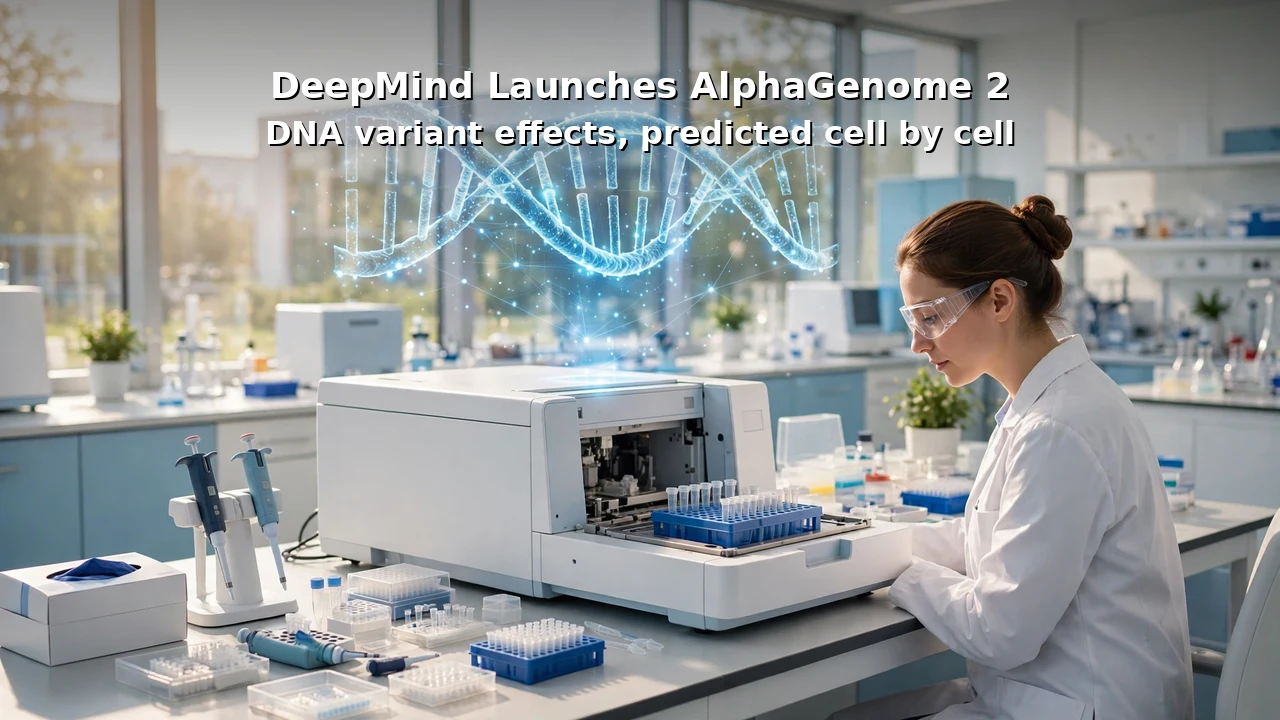
Google DeepMind introduced AlphaGenome 2 on Nov 11, a next-generation DNA sequence model that predicts how genetic variants affect hundreds of human cell types; it is available today to non-commercial researchers via the AlphaGenome API.
What happened
DeepMind announced AlphaGenome 2 in its official blog on Nov 11. The model reads one million DNA letters at a time and, given one biological condition — a tissue, cell type or cell state — predicts how a variant acts; the first AlphaGenome only predicted tissue-level averages, while version 2 narrows resolution to individual cell types. Training drew on bulk and single-cell data from human and mouse samples, more than 107 million individual cell profiles across 68 tissues.
The evaluation numbers come from TenK10K, a large single-cell map of 28 primary immune cell types: at 90% precision, AlphaGenome 2 recovered 30% of putatively causal expression-linked variants, against 16% for the first model fine-tuned on single-cell data; it got the direction of effect right 43% of the time, against 23%. The model also reproduced an inflammatory bowel disease study, pinpointing the causal variant driving overactivation of the ETS2 gene in gut macrophages.
Non-commercial research can use the model today via the AlphaGenome API, while commercial research enters a private preview. DeepMind precomputed predictions for trait-associated variants across hundreds of cell and tissue conditions for researchers to use directly; AlphaGenome 2 Skills are coming to Google Antigravity. The model is for research use only and has not been validated for clinical or diagnostic use; the community use-case call closes on Nov 30.
Key facts
- What it is: A next-generation DNA sequence model; one million DNA letters plus one biological condition per prediction, evaluated one condition at a time
- Training data: More than 107 million individual cell profiles across 68 tissues, from human and mouse bulk and single-cell data
- Benchmarks: On TenK10K, 30% of causal variants recovered vs 16%, and 43% correct direction vs 23%, at 90% precision
- Disease check: Reproduced an inflammatory bowel disease finding, pinpointing the causal variant for ETS2 in gut macrophages
- Availability: Open today to non-commercial research via the AlphaGenome API; commercial research in private preview
- Limits: Research use only, not validated for clinical or diagnostic use; community use-case call closes Nov 30
Why it matters
Variant effects can now be predicted for individual cell types; trained on 107 million cell profiles, the model narrows disease-linked variants from tissue level to cell level.
CompaniesGoogle
Grab todayOpenAI Codex for Students: $100 in Free CreditsHIMIAO Picks →Follow HIMIAO Horizon
No sign-up · Unsubscribe any timeNotifications
A ping on your phone or computer when the brief is out. No email needed.
Comments
Related
- Oct 28Google Genie 4: The World Model That Talks Back — and Rewrites Itself Mid-Run
- Oct 17Elorian Launches First Visual Reasoning Model Glimpse: Reasoning With Images
- Nov 7DeepMind Agents Find Two Weaknesses in Legacy 1024-Bit RSA
- Oct 14UK Parliament AI Safety Hearing: OpenAI and Anthropic Call for Binding Rules as Google and Meta Decline
- Oct 8Isomorphic Labs in Talks at a $40–50B Valuation; No Drug Yet in Human Trials
Today
Nov 12 Thursday- Brief
- GitHubGitHub Weekly Vol.5: 6 Projects Worth a Look This Week
Tested or read — weeklyAll →
- Quiz
- Call
Latest news
All →- Nov 12Kimi K3.1 Pro vs Qwen3.8-Max: Same $2 Input, $4 Apart on Output
- Nov 12NEAR AI Breached via SGLang Flaw, Exposing About 100 Users and 18 Agents
- Nov 12MiniMax Launches H3-Image: 4K Images in About 10 Seconds, Open Weights With a Restricted License
- Nov 12PLA-Linked Chinese University Bought Nvidia H200 Chips Despite US Blacklist
- Nov 12Ten AI Firms Sign Paris Call on AI Safety, Pledging Shutdown Mechanisms Without Penalties
- Nov 12OpenAI Acquires AI Travel Agent Odessia; Founder Joins, Service Shut Down