 ™
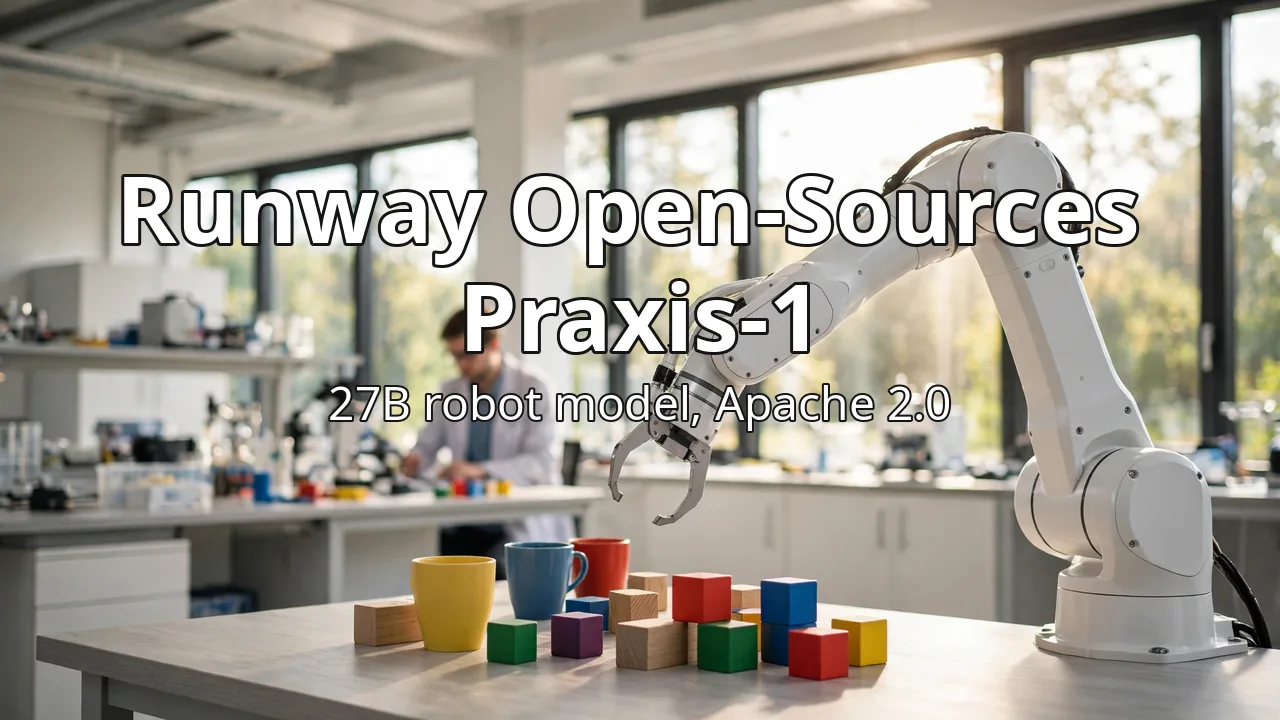
Runway Open-Sources Robot Model Praxis-1: 27B Parameters Under Apache 2.0
Runway opened the weights and fine-tuning code for robot model Praxis-1 on Nov 11 under Apache 2.0, including for commercial use; the 27B-parameter world-action model reaches 46.2% success on Nvidia's RoboLab-120.
What happened
Runway said on Nov 11 that robot model Praxis-1 is now available with open weights under the Apache 2.0 license, including for commercial use. Praxis-1 is a 27-billion-parameter mixture-of-experts diffusion transformer: it first predicts a short video of what happens next, then derives the robot's actions from that imagined future, an approach Runway calls a world-action model.
The release includes three checkpoints — the base model, a version fine-tuned on the DROID robot dataset and one fine-tuned for the bimanual YAM robot — plus inference code and full and LoRA fine-tuning code, on GitHub and Hugging Face, with native LeRobot support and vLLM-Omni, and hosted inference through Reactor. The model runs out of the box on Nvidia hardware, from H100 and B200 data-center GPUs to RTX 5090 and RTX PRO 6000 workstation cards and Jetson Thor on the robot itself.
Praxis-1 was first announced in September, when Runway committed to open-sourcing it; Nov 11 is the day the weights went public. The model first learns motion and object interaction from large-scale video, then is fine-tuned on robot data to map that knowledge onto physical actions. The full model is 54.4 GB in bfloat16 and needs a single 80 GB GPU; a 4-bit NVFP4 quantized version shrinks it to 17.5 GB.
Key facts
- Architecture: A 27-billion-parameter mixture-of-experts diffusion transformer that predicts video and actions together
- Benchmark: 46.2% on RoboLab-120 (555 of 1,200 episodes), ahead of FLUX 3 Action at 42.9%, Cosmos3 Nano at 36.8% and π0.5 at 28.0%; the top score among listed world-action models and open-source robot foundation models
- Second benchmark: After fine-tuning on Google's RT-1 robot data, 80.0% average across four SimplerEnv tasks, against 52.4% for the original RT-1 model
- Figures: All figures above are Runway's own, with no independent replication yet; 46.2% still means failing more than half of the simulated tabletop tasks
- Release contents: Three checkpoints (base, DROID fine-tuned, YAM bimanual fine-tuned) plus inference and full/LoRA fine-tuning code; GitHub, Hugging Face with native LeRobot support, vLLM-Omni, and hosted inference on Reactor
- Hardware and size: The full bfloat16 model is 54.4 GB and needs a single 80 GB GPU; the NVFP4 quantized version is 17.5 GB; runs on H100/B200, RTX 5090/PRO 6000 and Jetson Thor
Why it matters
Open weights plus full fine-tuning code let small teams adapt a robot model on their own hardware, adding another reproducible open implementation of video pretraining for robot control.
Follow HIMIAO Horizon
No sign-up · Unsubscribe any timeNotifications
A ping on your phone or computer when the brief is out. No email needed.
Comments
Related
- Nov 12MiniMax Launches H3-Image: 4K Images in About 10 Seconds, Open Weights With a Restricted License
- Nov 11DeepMind Launches Gemini Robotics 2.5 With 96% Success on Mercedes Lines
- Nov 11NVIDIA Unveils GR00T 2 Robot Model
- Nov 9Kimi K3.1 Pro Review: 2.8T Open Weights, Near-Flagship Terminal Coding, Lagging Science Tasks
- Nov 7NVIDIA Releases Four Cosmos 3 Open Weights: 16B World Models for Driving Data and Robot Simulation
Today
Nov 14 Saturday- BriefJensen Huang Resigns as Nvidia CEO; CFO Kress Named Interim Chief
12 stories · Nov 13
- GitHubGitHub Weekly Vol.5: 6 Projects Worth a Look This Week
Tested or read — weeklyAll →
- Quiz
- Call
Latest news
All →- Nov 13ByteDance Launches Seedance 2.5 Flash: Twice the Speed at About ¥0.99 per Second
- Nov 13Samsung Gemini Smart Glasses Open for Preorders From $395, Shipping Dec 10
- Nov 13OpenAI Launches Daybreak Red Team and Defense Factory Security Tools
- Nov 13Jensen Huang Resigns as Nvidia CEO; CFO Kress Named Interim Chief
- Nov 13Anthropic Opens Self-Hosted Claude Managed Agents in Private Beta
- Nov 13Alibaba Plans to Spin Off T-Head Chip Unit for Hong Kong Listing