 ™
Nvidia Launches Nemotron for Science, Bringing AI Agents to the Lab
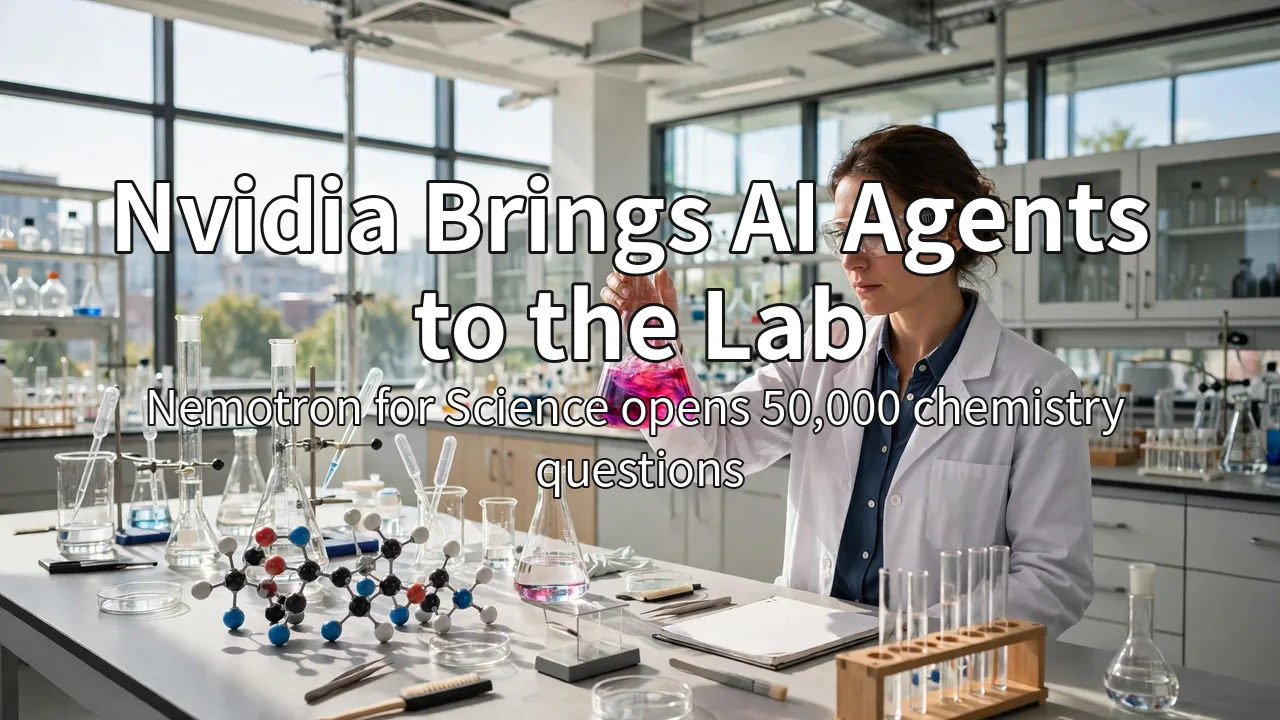
Nvidia introduced Nemotron for Science at SC26 on Nov 16, packaging the open Nemotron 3.5 Super VL model, the LitmusBench v0.2 chemistry dataset of nearly 50,000 questions and post-training recipes for researchers building science agents.
What happened
The package has three parts: the Nemotron 3.5 Super VL vision-language model, open-sourced on Hugging Face in October (120B total parameters, 12B active per token, up to 1M tokens of context); the new LitmusBench v0.2 dataset of nearly 50,000 chemistry reasoning questions (47,118 training, 2,056 test); and post-training recipes for chemistry, life sciences and materials; the model and dataset are available on Hugging Face now.
Nvidia positions the package for researchers building science agents on their own systems: the agent reads a scientific problem, then calls CUDA-X accelerated scientific software to plan experiments, run code and check results; an agent at Argonne National Laboratory used the toolkit to take a single prompt, plan and test hypotheses, choose simulations and identify two new binding sites.
Partner results are vendor-reported: Lila Sciences reached 61% accuracy in quantum-dot synthesis prediction with Nemotron; an agent at KTH Royal Institute of Technology repaired 81% of deliberately broken GROMACS molecular-dynamics setups in a single overnight run, with every fix checked by GROMACS itself; life sciences companies Terray Therapeutics and Therna are also customising the model.
Key facts
- Launch: Announced at SC26 on Nov 16 by Ian Buck, Nvidia vice president of hyperscale and HPC
- Model: Nemotron 3.5 Super VL: 120B total parameters, 12B active per token, up to 1M tokens of context, open-sourced in October
- Dataset: LitmusBench v0.2: nearly 50,000 chemistry reasoning questions (47,118 training, 2,056 test), sourced in part from ChEMBL v36
- Recipes: Post-training recipes for chemistry, life sciences, protein design and materials
- Deployment: Runs on DGX Spark, a local workstation or a researcher's own supercomputer; the model and dataset are on Hugging Face
- Cases: An Argonne agent found two new binding sites from a single prompt; Lila reached 61% accuracy in quantum-dot synthesis prediction (vendor-reported)
- Repair: A KTH agent repaired 81% of broken GROMACS setups overnight (vendor-reported)
Why it matters
the model itself was open-sourced in October, and what is new is the dataset and recipes around it; an Argonne Lab agent already used them to plan experiments from a single prompt and identify two new binding sites.
CompaniesNVIDIA
Grab todayOpenAI Codex for Students: $100 in Free CreditsHIMIAO Picks →Follow HIMIAO Horizon
No sign-up · Unsubscribe any timeNotifications
A ping on your phone or computer when the brief is out. No email needed.
Comments
Related
- Oct 26NVIDIA Nemotron 3.5 Bolt E4B Review: A Local Agent in 4GB of VRAM
- Oct 24NVIDIA Releases Nemotron 3.5 Bolt E4B: Local Agents on 4GB of VRAM
- Oct 13NVIDIA Releases Nemotron 3.5 Bolt 74B: A Local-Agent Model Packed Into 24GB
- Oct 8White House Announces $2.4B in AI-for-Science Tool and Compute Credit Pledges From 11 Companies
- Nov 15Meituan Open-Sources LongCat-2.5 Weights: 1.6T-Parameter Agent Model Trained Without Nvidia Chips
Today
Nov 19 Thursday- Brief
- GitHubGitHub Weekly Vol.6: 7 Projects Worth a Look This Week
Tested or read — weeklyAll →
- Quiz
- Call
Latest news
All →- Nov 19MAI Code 2 vs Claude Opus 5.5 and GPT-6.1 Sol: $0.50 Input vs $4, Promo Price Until May 2027
- Nov 18Study: Frontier Models Can Be Tricked Into Marking Civilian Targets
- Nov 18Nvidia Reaffirms Open-Source Strategy, Hugging Face Deal on Track
- Nov 17Klarna Launches AI Assistant That Shops, Books and Runs Errands
- Nov 18Palo Alto to Buy Applied Compute for $4.5 Billion in All-Stock Deal
- Nov 18NGINX2Root Exposed: Five 9.2-Severity Flaws Let Attackers Run Code on Nginx Without Logging In