 ™
OpenAI Healthcare Agents Enter Hospitals as GPT-6 Astra Drives EHR Screens
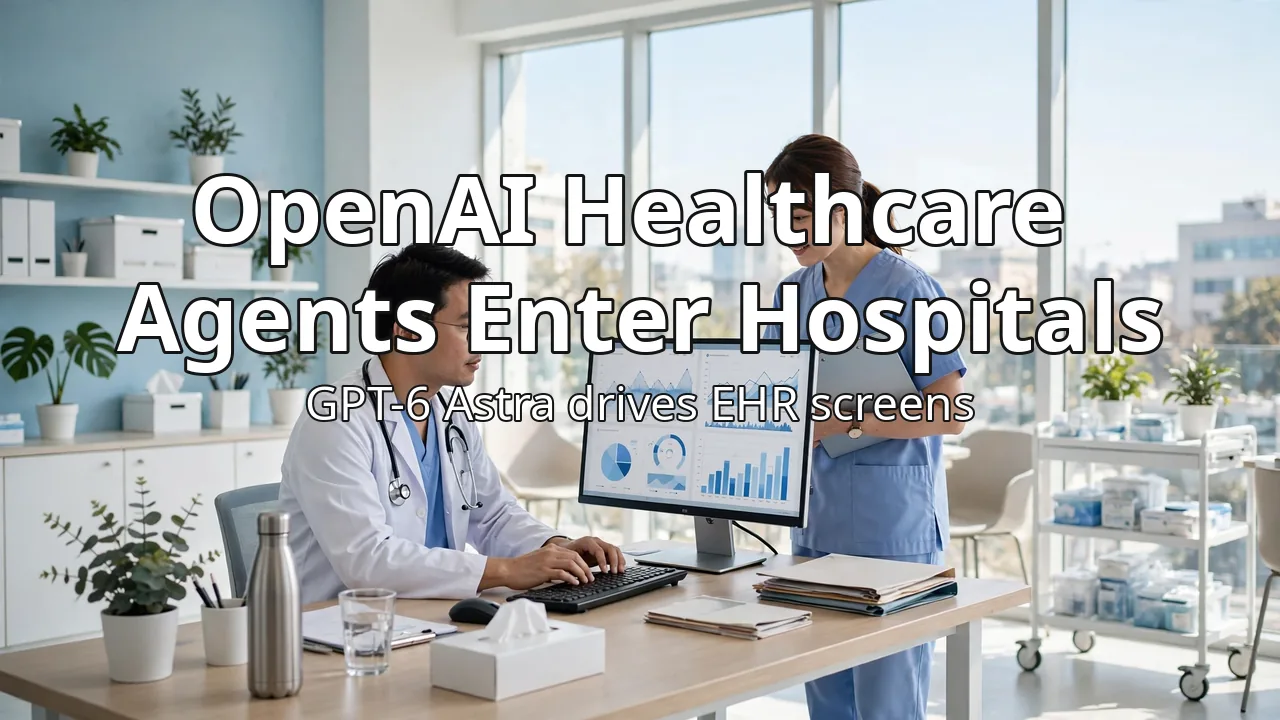
OpenAI said on Nov 16 at HLTH that ChatGPT for Healthcare now has computer-use agents that read screens, click and type directly inside electronic health records and insurer portals; CVS Health and Cigna are already using them in production.
What happened
Computer-use agents carry out multi-step work by reading screens, clicking and typing inside the software healthcare teams already use, covering referrals, prior authorizations, discharge planning and outreach between visits. OpenAI says the agents handle steps that APIs do not fully support, while clinicians remain responsible for decisions requiring clinical judgment.
The evaluation figures come from tests published by OpenAI: physicians reviewed 325 EHR-inbox tasks and rated 99% of them safe; in 646 physician assessments, 93% rated the work “very helpful” or “extremely helpful.” On HealthAdminBench, an independent benchmark from Stanford researchers, GPT-6 Astra earned 94.3% of available rubric points and GPT-6 Luna earned 91.8%, with Luna costing 98% less at 8.5 cents per task.
Deployments are already live: CVS Health uses the agents in production for repetitive work across clinical systems — one workflow cleared a months-long document-sending backlog over a weekend, another handles the system steps for tens of thousands of consults each day — and CVS is open sourcing its Agent Kit. Cigna case managers previously gathered context across more than 10 separate systems; computer use now brings it together in seconds. Abridge and Ambience are developing or piloting; OpenAI also launched more than 20 healthcare plugins covering scheduling, insurance verification and hospital workflows.
Key facts
- Access: OpenAI API, ChatGPT for Healthcare and ChatGPT for Clinicians (free for eligible US clinicians); ChatGPT Work and Codex require a workspace administrator to enable computer use
- Models: GPT-6 Astra leads; GPT-6 Luna handles high-volume administrative tasks
- Clinical safety: 99% of 325 tasks rated safe; 93% of 646 assessments rated very or extremely helpful
- Admin benchmark: HealthAdminBench (Stanford independent benchmark): Astra 94.3%, Luna 91.8%, Luna at about 8.5 cents per task, 98% less
- Plugins: More than 20 new healthcare plugins, including Aiva, Amion, Availity, Elation, IMO Health, K Health, Luma, Notable, Oracle HDI, Redox, Stedi, TriZetto, Turquoise and UpToDate
- Deployments: CVS in production, clearing a months-long document backlog over a weekend; Cigna case managers now gather context from 10-plus systems in seconds; CVS open sourcing its Agent Kit
- Compliance: Workflows involving protected health information require a Business Associate Agreement and the required security and retention settings; organization data is not used to train OpenAI foundation models
- Caveat: The safety and helpfulness scores come from physician review and benchmark testing, not from real clinical outcomes
Why it matters
The agents skip system integration and operate the software hospitals already use, with CVS and Cigna running them in production; the 99% clinical-safety figure comes from physician review, and real clinical outcomes remain to be verified.
CompaniesOpenAI
Grab todayOpenAI Codex for Students: $100 in Free CreditsHIMIAO Picks →Follow HIMIAO Horizon
No sign-up · Unsubscribe any timeNotifications
A ping on your phone or computer when the brief is out. No email needed.
Comments
Related
- Nov 14OpenAI Launches ChatGPT Wallet, Letting Dots Agents Pay for Purchases
- Nov 12OpenAI to Retire ChatGPT's Legacy Voice Modes on Dec 11, Leaving GPT-Live Only
- Nov 11OpenAI Turns ChatGPT Into a Business Directory With Profiles and AI Agents
- Nov 10ChatGPT Enterprise Lands on AWS Marketplace, Payable on AWS Billing
- Nov 5OpenAI Says ChatGPT Search Is About a Fifth of Google's
Today
Nov 19 Thursday- Brief
- GitHubGitHub Weekly Vol.6: 7 Projects Worth a Look This Week
Tested or read — weeklyAll →
- Quiz
- Call
Latest news
All →- Nov 19MAI Code 2 vs Claude Opus 5.5 and GPT-6.1 Sol: $0.50 Input vs $4, Promo Price Until May 2027
- Nov 18Study: Frontier Models Can Be Tricked Into Marking Civilian Targets
- Nov 18Nvidia Reaffirms Open-Source Strategy, Hugging Face Deal on Track
- Nov 17Klarna Launches AI Assistant That Shops, Books and Runs Errands
- Nov 18Palo Alto to Buy Applied Compute for $4.5 Billion in All-Stock Deal
- Nov 18NGINX2Root Exposed: Five 9.2-Severity Flaws Let Attackers Run Code on Nginx Without Logging In