 ™
Google Picks Blue Origin to Launch AI Compute Satellites in 2029
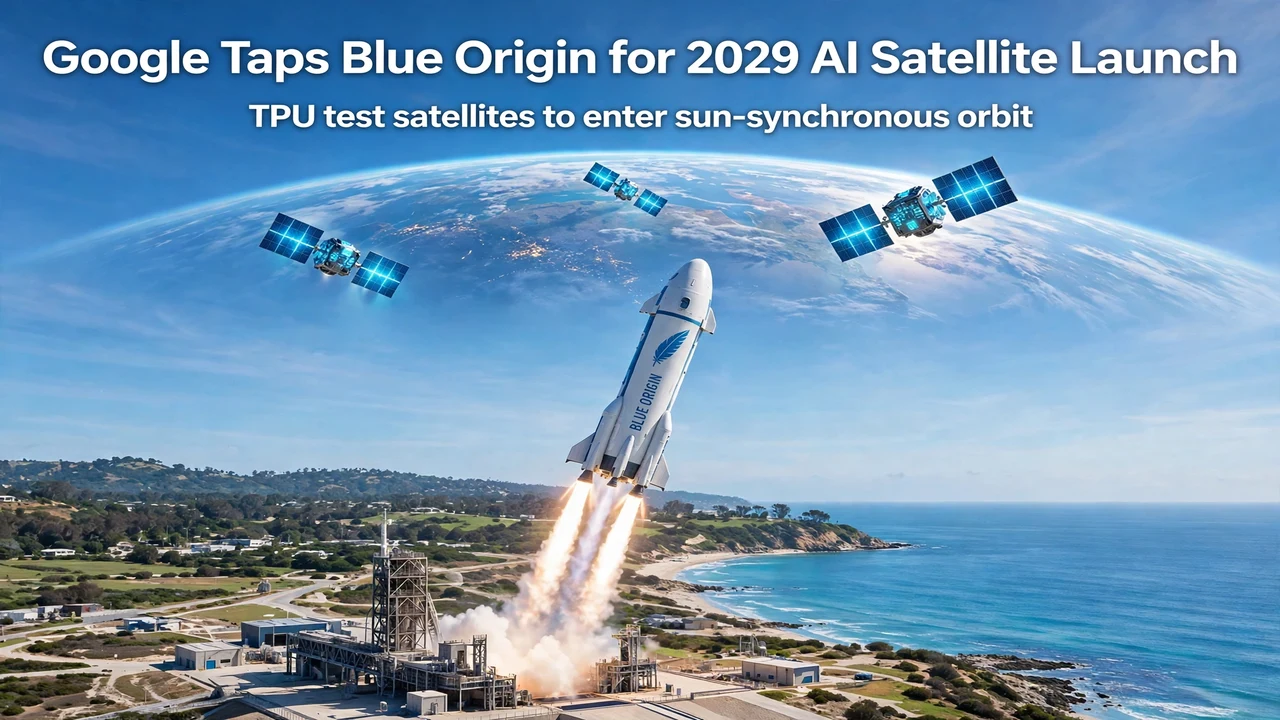
Google and Blue Origin announced on November 19 a launch services agreement under which Blue Origin's New Glenn heavy-lift rocket will launch multiple TPU-equipped AI compute satellites for Google's Project Suncatcher in the first quarter of 2029.
What happened
The agreement is Google's first heavy-lift launch dedicated to Suncatcher. A Google research blog post the same day said the satellites will enter a sun-synchronous orbit with near-constant sunlight, powered by orbital solar energy, to test whether computing in space is feasible.
The first Suncatcher prototype satellite was already launched on October 1 by a SpaceX rocket in cooperation with Planet Labs and is operating normally. Each satellite carries Google's own TPU, with computing power roughly equal to one rack of servers in a ground data center.
The 2029 date is only a target. Reuters noted that orbital data centers are still years away from commercial use, with high launch costs, engineering difficulty and satellite production capacity as obstacles; Blue Origin itself has a record of delays, and a launch-pad explosion occurred in May.
Key facts
- Launch date: The New Glenn heavy-lift rocket is to launch multiple Suncatcher satellites in the first quarter of 2029
- First prototype: Launched on October 1 by a SpaceX rocket with Planet Labs and operating normally
- Per-satellite compute: Each satellite carries Google's own TPU, with compute roughly equal to one rack of servers in a ground data center
- Orbit and power: A sun-synchronous orbit with near-constant sunlight, powered by orbital solar energy
- Project nature: A research experiment to test whether computing in space is feasible, not a commercial deployment
- Distance to commercial use: Reuters noted orbital data centers are still years from commercial use; Blue Origin has a record of delays and a launch-pad explosion in May
Why it matters
this is Google's first time sending its own TPUs into orbit to test space-based computing, and 2029 is only a target date.
CompaniesGoogle
Grab todayAdobe Creative Cloud Pro: 57% off first yearHIMIAO Picks →Follow HIMIAO Horizon
No sign-up · Unsubscribe any timeNotifications
A ping on your phone or computer when the brief is out. No email needed.
Comments
Related
- Nov 10Google Adds TPU 8tx and 8i Max to Eighth-Gen Lineup
- Oct 29Gemini 4 Carbon vs GPT-6.1 Terra: Two New Models in One Week, Double the Price Gap and an 8.4-Point Index Gap
- Oct 29Google Unveils Gemini 4 Carbon: Its Strongest Cybersecurity Frontier Model, Defenders First
- Nov 16Kuo: OpenAI and Anthropic to Buy About 26M Google TPUs in 2028–29
- Nov 15SemiAnalysis Names Nvidia's Seven Biggest GPU Customers; Six Build Their Own Chips
Today
Nov 23 Monday- Brief
- GitHubGitHub Weekly Vol.7: 7 Projects Worth a Look This Week
Tested or read — weeklyAll →
- Quiz
- Call
Latest news
All →- Nov 23GitHub Weekly Vol.7: 7 Projects Worth a Look This Week
- Nov 23Alibaba Qwen4-Max Review: Intelligence Index 43, Task Costs Down 58%, Terminal Coding Trails Kimi
- Nov 23US Intel Chief Confirms China Obtained Nvidia's Top AI Chips
- Nov 23OpenAI Chief Scientist: Perplexity Tracks Intelligence, Calls for Shared Limits
- Nov 23AI Agents Breached a Medical Imaging Server in 11 Minutes; MONAI Label Zero-Day Now Fixed
- Nov 23Tampered DeepSeek Model Served for 53 Hours; Refusals Fell From 98% to 1%