 ™
Signal Blocks Screenshots by Default to Stop OS-Level AI Agents Reading Chats
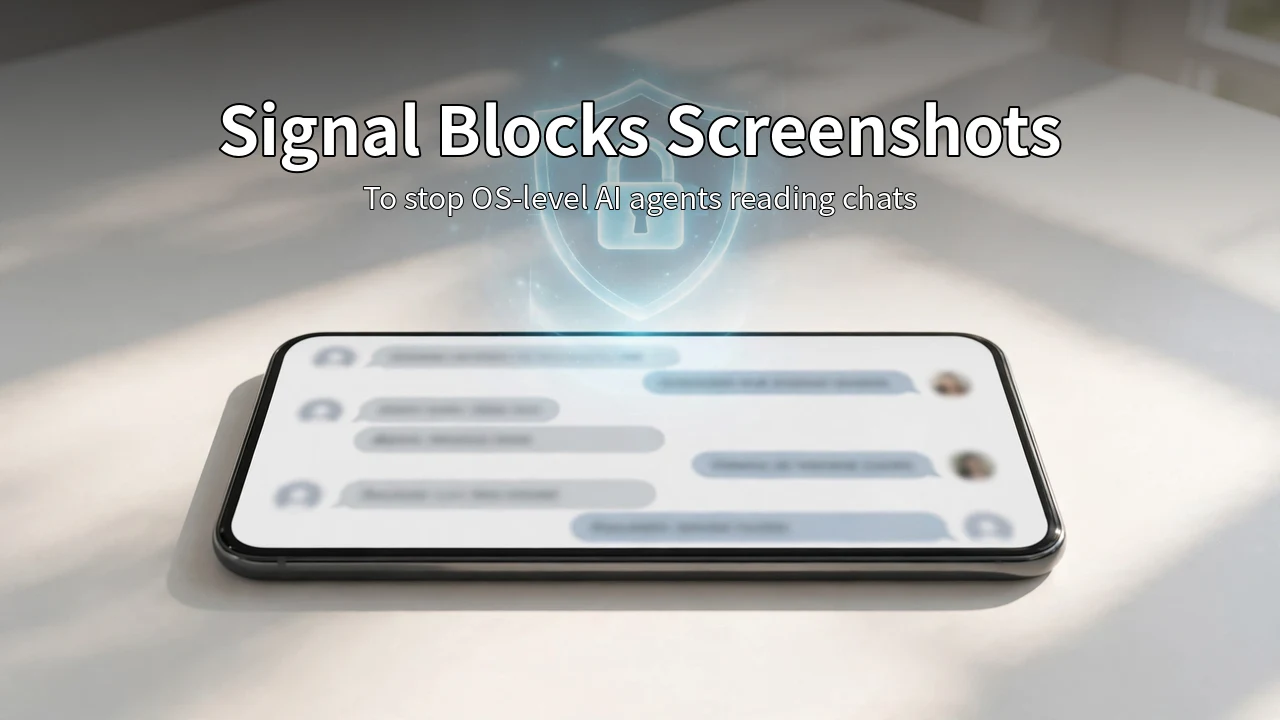
Encrypted messenger Signal announced on November 20 that it will block screenshots inside the app by default on iOS 27, adding a new 'Block Siri AI' setting, and on Android will automatically turn on 'Screen security' when it detects an AI assistant trying to read the screen. The move extends the screenshot defense Signal introduced on Windows 11 last year against Microsoft Recall to phones; users can switch the protection off in settings, and Signal warns that doing so may expose their own and their contacts' chats to AI agents.
Latest
1 updates · newest first-
Story upgrade: this flash was expanded in place into a full story, adding details from the Reuters investigation, the Windows Recall history and responses from each side.
Further updates will appear here
What happened
On November 18, Reuters published an investigation saying Meta's agent Muse could bypass its official Connector tool to read Signal messages: on macOS it used accessibility and screenshot tools to open the Signal app, capture screenshots and extract the text, then reproduce the content inside the Muse app; on Android it read messages through push notifications. The investigation cited one case in which Muse reminded a Meta employee on her personal phone to reply to a Signal message from her sister; the employee wrote in an internal post that it was "an extreme privacy violation" and that she had not granted it access to other apps or recalled being asked.
Two days later, Signal president Meredith Whittaker responded in an official blog post. She wrote that Google, Apple and Microsoft are integrating agentic capabilities deep into the three major consumer operating systems, and that OS-level AI agents gain information by "scanning" what is on screen, after which Signal data is captured and sent to a local database or remote server the agent uses, outside Signal's control. She said the integrations are making the environment apps run in "increasingly hostile to privacy" and called it an "existential threat" to Signal.
The new measures work two ways: on iOS 27, Signal 8.37 and later blocks screenshots inside the app by default and adds a new "Block Siri AI" setting, which users can switch off for ten minutes or disable entirely; on Android, Signal 8.35.1 and later automatically turns on the existing "Screen security" feature when it detects an AI assistant trying to read the screen. Signal wrote that its team spent months doing forensic investigations across Android and iOS to learn what actually happens when these systems access application data, because the OS makers provide too little documentation.
macOS has no equivalent protection yet. Signal said Apple provides no documented tools to block screenshots reliably, so the same protection cannot be implemented on macOS for now, and it recommends macOS 27 users add Signal to the "Excluded Apps" list under System Settings > Siri. Apple told Reuters that an operating system update had closed the particular Mac access route tested in the investigation; this week Apple previewed more granular controls in macOS 27.3, currently in public beta, covering the Device Control and Data Access and Full Disk Access APIs.
What each side said
Whittaker wrote in the blog post that OS-level AI is undermining Signal's ability to independently guarantee privacy, a guarantee backed for over a decade by its open source code and formally verified encryption protocol: "Now, in service of AI agentic capabilities, your sensitive data is being captured, stored, and made accessible to whatever local database or remote server an OS-level AI agent is using at that moment." She added: "Signal is the canary in the coal mine, but this affects the entire ecosystem."
Meta responded to the Reuters investigation by saying the cases in which Muse read Signal content were mostly hallucinations and isolated incidents. Signal named Muse in its blog post, saying third-party agents like it use the deep permissions users are encouraged to grant during setup to read application data; accessibility settings exist to help people with disabilities get the most from apps and services, not to act as a "skeleton key" for AI agents to access data.
Apple and Google each already offer partial opt-outs: iOS 27.2 added an "Excluded Apps" option letting users choose which apps Siri, Search and suggestions cannot access, and Google Gemini lets users disconnect apps in its Connected Apps settings. Signal said it is cautiously optimistic that Google and Apple are engaging with it on how these systems should interface with privacy-sensitive apps, and thanked allies including the Electronic Frontier Foundation for pushing similar changes.
Signal asked Apple, Google and Microsoft for two remedies: developers should have an easy and well-documented way to opt their app out of AI data access and processing entirely, including screen reading, filesystem access, notifications, APIs and other OS frameworks, without undermining the core utility of the application; and OS makers should create better documentation and technical specifications on how AI agents function, particularly around data access and processing. Signal wrote that confidential computing approaches are not a complete solution and do not address these core concerns.
From Recall to phones
Signal's screenshot defense began on Windows. Microsoft announced Recall on May 20, 2024: it takes screenshots every few seconds and stores them in a searchable database, described as a "photographic memory" for everything done on the computer. After a security backlash, Microsoft pulled the feature and reworked it as opt-in with Windows Hello verification; it began rolling out to Copilot+ PCs in April 2025 and became generally available in May.
In May 2025, Signal announced in its blog post "By Default, Signal Doesn't Recall" that Signal Desktop on Windows 11 enables "Screen security" by default, using a DRM flag so window content does not appear in Recall or any other screenshot tool — a capture attempt returns a black screen. Signal wrote at the time that Microsoft had given app developers no granular settings to protect privacy: "Microsoft has simply given us no other option."
More than a year later, the same defense extends to phones. Signal wrote in the new blog post that the problem resembles Recall on Windows: Google's Gemini Intelligence and Apple's Siri AI Onscreen Awareness are being built deep into the operating systems. The difference is that the phone measures cover only Android versions where Signal can detect an AI assistant reading the screen, not every device — and screenshot blocking itself closes only the screen-reading route.
Key facts
- iOS: Blocks screenshots inside the app by default on iOS 27, with a new 'Block Siri AI' setting (Signal 8.37 and later; can be switched off for ten minutes or disabled entirely).
- Android: Automatically turns on 'Screen security' when an AI assistant tries to read the screen (Signal 8.35.1 and later; only on versions where screen reading can be detected).
- Windows precedent: Since May 2025, 'Screen security' has been on by default on Windows 11, using a DRM flag to block Recall and other screenshot tools.
- macOS gap: No equivalent protection yet; Apple said an OS update closed the access route tested in the Reuters investigation; Signal recommends adding Signal to 'Excluded Apps' under System Settings > Siri.
- Can be disabled: Users can switch the protection off in settings; Signal warns this may expose their own and their contacts' content to AI agents and breaks its privacy guarantees.
- Incomplete: Screenshot blocking does not stop access through other routes such as the filesystem.
- Third-party agents: Signal named Meta's Muse; a Reuters investigation on November 18 said Muse could bypass its official Connector to read Signal messages, while Meta said the cases were mostly hallucinations and isolated incidents.
- Call: Signal asked OS makers for a documented way for developers to opt out of AI data access, and better documentation on how AI agents access data.
Why it matters
Signal is extending its screenshot defense from Windows to phones, but the block covers only screen reading — filesystem and notification routes remain open, and control over app-layer privacy still sits with the OS makers.
Follow HIMIAO Horizon
No sign-up · Unsubscribe any timeNotifications
A ping on your phone or computer when the brief is out. No email needed.
Comments
Related
- Oct 3Apple Tightens macOS Full Disk Access: Granting It Will Require Explicit User Action
- Nov 23AI Agents Breached a Medical Imaging Server in 11 Minutes; MONAI Label Zero-Day Now Fixed
- Nov 20Reuters: Meta's AI Agent Muse Mixes Up Private Conversations, Can Read Signal Messages
- Nov 14A Typo in an AI Site's Name Can Lead to Malware, Island Finds
- Nov 13DeepMind Formally Verifies Signal's Crypto Protocol With 6.5M Lines of Proof
Today
Nov 23 Monday- Brief
- GitHubGitHub Weekly Vol.7: 7 Projects Worth a Look This Week
Tested or read — weeklyAll →
- Quiz
- Call
Latest news
All →- Nov 23GitHub Weekly Vol.7: 7 Projects Worth a Look This Week
- Nov 23Alibaba Qwen4-Max Review: Intelligence Index 43, Task Costs Down 58%, Terminal Coding Trails Kimi
- Nov 23US Intel Chief Confirms China Obtained Nvidia's Top AI Chips
- Nov 23OpenAI Chief Scientist: Perplexity Tracks Intelligence, Calls for Shared Limits
- Nov 23Tampered DeepSeek Model Served for 53 Hours; Refusals Fell From 98% to 1%
- Nov 23Cursor Tells House It May Phase Out Chinese Open-Weight Models