 ™
Bessent: Trump and Xi Agreed Military AI Decisions Must Involve Humans
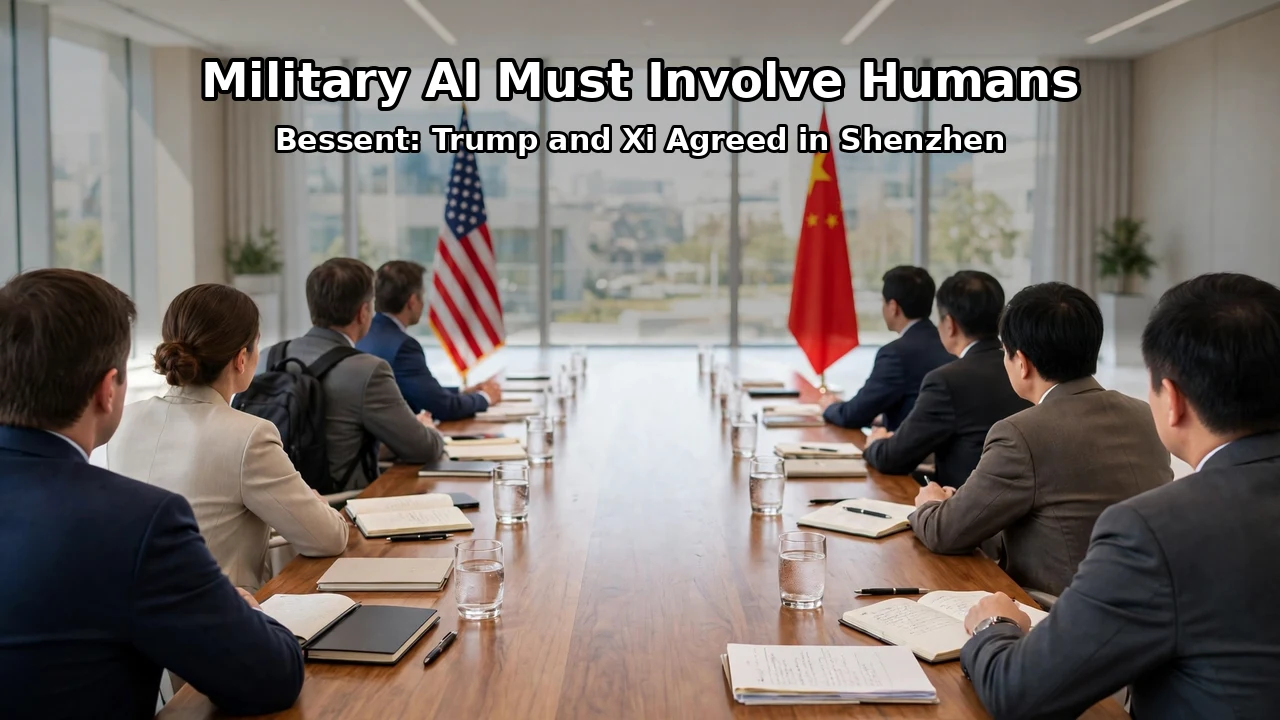
Treasury Secretary Scott Bessent said on CNBC on November 20 that, according to his account, Trump and Xi agreed in their Shenzhen meeting that military decisions using AI technology must always involve humans, and AI must not autonomously launch major military operations. No written document or confirmation from Beijing has been published.
What happened
Bessent spoke to CNBC after returning from Trump's Asia trip, describing the outcome of the Shenzhen meeting with Xi. He listed human control of military AI among the trip's "major achievements" and said the understanding was unaffected by the two countries' competition in AI.
According to Bessent, Trump and Xi agreed that humans must always be involved in any military decision using AI technology, and that AI must not be allowed to act autonomously in major military operations. He said the two sides also agreed on other safeguards but did not describe them.
Both sides agree that no major military operation should be launched without a human being involved.
— Treasury Secretary Scott Bessent, speaking to CNBC
As of publication, the account comes only from Bessent. No written document, joint statement, or confirmation from Beijing has been published. Reuters' report also attributes the account to Bessent.
Key facts
- When and where: Bessent spoke to CNBC on Friday, November 20, relaying an understanding reached in the Trump-Xi meeting in Shenzhen
- What was agreed: Military decisions using AI technology must always involve humans; AI must not autonomously launch major military operations
- Bessent's characterisation: The understanding was among the "major achievements" of the Asia trip and is unaffected by US-China competition in AI
- H200 chips: The H200 remains the most advanced chip China can buy with licences; Bessent said Chinese H200 orders have been sparse as Beijing builds its own chip stack and is "probably many years behind"
- Huang allegations: Bessent said spying allegations involving Nvidia's Jensen Huang did not come up in the bilateral meeting
- Inter-agency differences: Bessent said differences between Treasury and Commerce on chip controls had been downplayed, with officials "all committed to following the President's instructions"
- Context: On November 16 the Commerce Department issued a new rule restricting China's remote use of advanced chips via overseas data centres; it took effect on November 19
- Technology lead: Bessent said US AI labs need to maintain their technological lead against Chinese AI models being used in cyberattacks
Why it matters
According to Bessent, the two leaders reached an oral understanding on human control of military AI, the first such public signal between the US and China in AI governance.
CompaniesUS government
Grab todayAdobe Creative Cloud Pro: 57% off first yearHIMIAO Picks →Follow HIMIAO Horizon
No sign-up · Unsubscribe any timeNotifications
A ping on your phone or computer when the brief is out. No email needed.
Comments
Related
- Nov 22Trump Says He Discussed Jensen Huang With Xi; Bessent Says H200 Remains China Export Cap
- Nov 21Trump: US Firms Building Data Centers Abroad Will Face "Tremendous Tax"
- Nov 20US Weighs Forcing Firms to Disclose Chinese AI Use
- Oct 11White House Tells AI Companies Incident Reporting Is Mandatory, After Anthropic's Disclosure
- Oct 4White House Stands Up 'Super Intelligence Force': DNI Jay Clayton to Lead, Report Due in 120 Days
Today
Nov 23 Monday- Brief
- GitHubGitHub Weekly Vol.6: 7 Projects Worth a Look This Week
Tested or read — weeklyAll →
- Quiz
- Call
Latest news
All →- Nov 23Alibaba Qwen4-Max Review: Intelligence Index 43, Task Costs Down 58%, Terminal Coding Trails Kimi
- Nov 23US Intel Chief Confirms China Obtained Nvidia's Top AI Chips
- Nov 23OpenAI Chief Scientist: Perplexity Tracks Intelligence, Calls for Shared Limits
- Nov 23AI Agents Breached a Medical Imaging Server in 11 Minutes; MONAI Label Zero-Day Now Fixed
- Nov 23Tampered DeepSeek Model Served for 53 Hours; Refusals Fell From 98% to 1%
- Nov 23Cursor Tells House It May Phase Out Chinese Open-Weight Models