 ™
Photonic Chips Run AI: Q.ANT Pilots in IONOS Data Centers
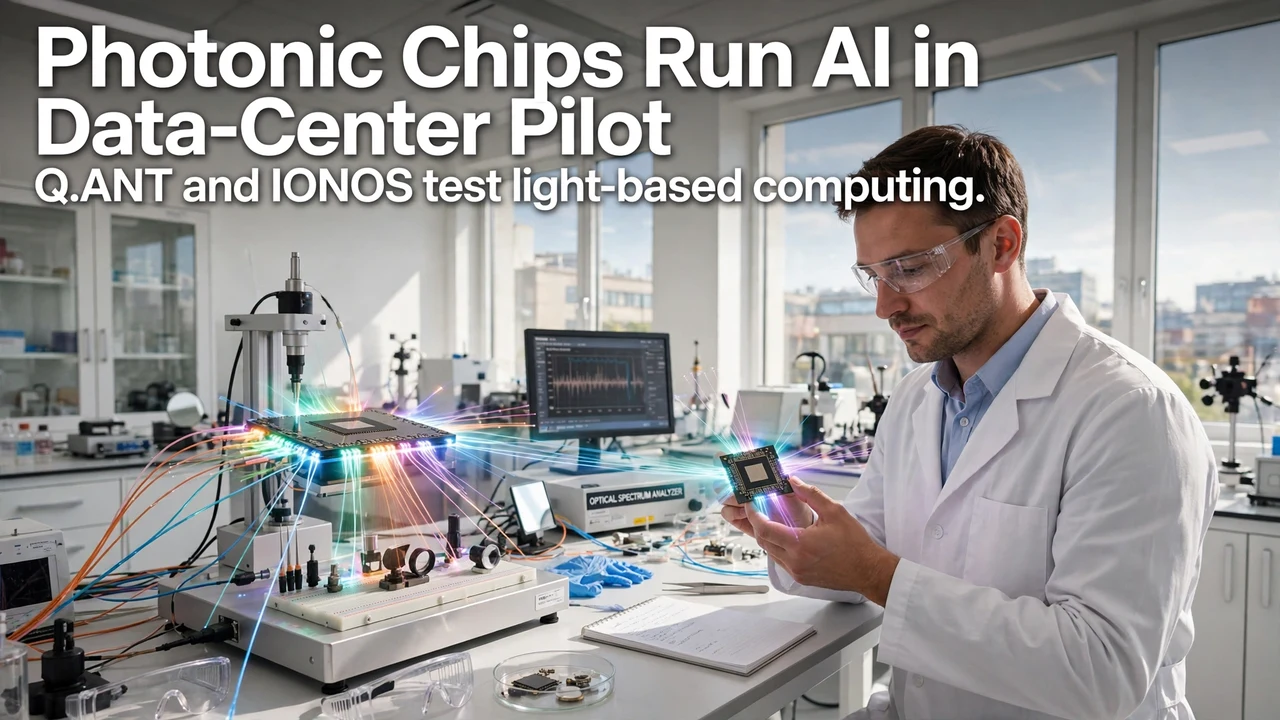
German company Q.ANT's photonic processors have entered a commercial data-center pilot: cloud provider IONOS has deployed the chips in its facilities, and more than 30 engineering teams are developing AI models tuned for photonic computing.
What happened
Photonic processors divide the work differently from GPUs: GPUs move data with electrons and excel at linear math such as masses of additions and multiplications, while photonic processors compute with light waves, which generate almost no heat as they travel and process more data at once, suiting complex nonlinear work such as image segmentation and object detection. Q.ANT positions its chips not as GPU replacements but as coprocessors running alongside GPUs, completing complex math in a single step where conventional chips need thousands.
In an interview published by WIRED on November 27, Q.ANT founder and CEO Michael Förtsch said earlier this month that energy cost is the key constraint on AI development and memory access is today's biggest cost driver. The company fabricates its chips on the mature 90-nanometer process, without depending on cutting-edge nodes; the chips are not tied to any GPU brand and can pair with NVIDIA, AMD or other processors. On November 18, the company unveiled its enhanced second-generation NPU Gen 2+ at the SC26 supercomputing conference, adding optical discrete Fourier transforms, and demonstrated it running a large language model alongside an AMD GPU.
The energy figures remain simulations for now: Q.ANT says simulations show 4 to 5 times lower energy for certain nonlinear tasks when paired with CPUs and GPUs, while acknowledging the numbers have not yet been validated on production hardware and real-world gains may be lower. In March, second-generation photonic processors were deployed at the Leibniz Supercomputing Centre (LRZ); the vendor claims more than 50 times higher matrix-multiplication throughput, 25 times faster ResNet-18 inference and 6 times lower energy for typical workloads, all vendor-reported figures.
Key facts
- Pilot: IONOS data centers have deployed Q.ANT chips; more than 30 engineering teams are developing AI models tuned for photonic computing.
- Energy figures: simulations claim 4 to 5 times lower energy for certain nonlinear tasks; not yet validated on production hardware, and real-world gains may be lower.
- Process and role: 90-nanometer mature process; a GPU coprocessor, not a GPU replacement; not tied to any GPU brand.
- New product: NPU Gen 2+ unveiled on November 18 at SC26, adding optical discrete Fourier transforms; commercial systems planned for the second half of 2027.
- Earlier deployment: second-generation processors were deployed at the Leibniz Supercomputing Centre (LRZ) in March, entering production-grade evaluation.
Why it matters
photonic computing has entered a commercial data-center pilot for the first time; simulations claim 4 to 5 times lower energy for certain nonlinear tasks, but no measured results have been published and the savings still await verification.
Follow HIMIAO Horizon
No sign-up · Unsubscribe any timeNotifications
A ping on your phone or computer when the brief is out. No email needed.
Comments
Today
Nov 27 Friday- Brief
- GitHubGitHub Weekly Vol.7: 7 Projects Worth a Look This Week
Tested or read — weeklyAll →
- Quiz
- Call
Latest news
All →- Nov 27Sand.ai Launches MAGI-2: 30-Second 1080p Video With Synced Sound
- Nov 27NVIDIA Opens Image Model Weights: 30B Parameters, 3B Active per Token
- Nov 27Meta Declines Joint FCA Test of Muse
- Nov 27Probe Says Novita, StreamLake Route Requests to ByteDance's Ark
- Nov 27Ant Releases Ling-3.2-air Weights: 124B Parameters Under MIT License
- Nov 27GPT-6.2 Astra Review: Intelligence Index 62, Coding 91.9% at No. 1