
Apple Tightens macOS Full Disk Access: Granting It Will Require Explicit User Action
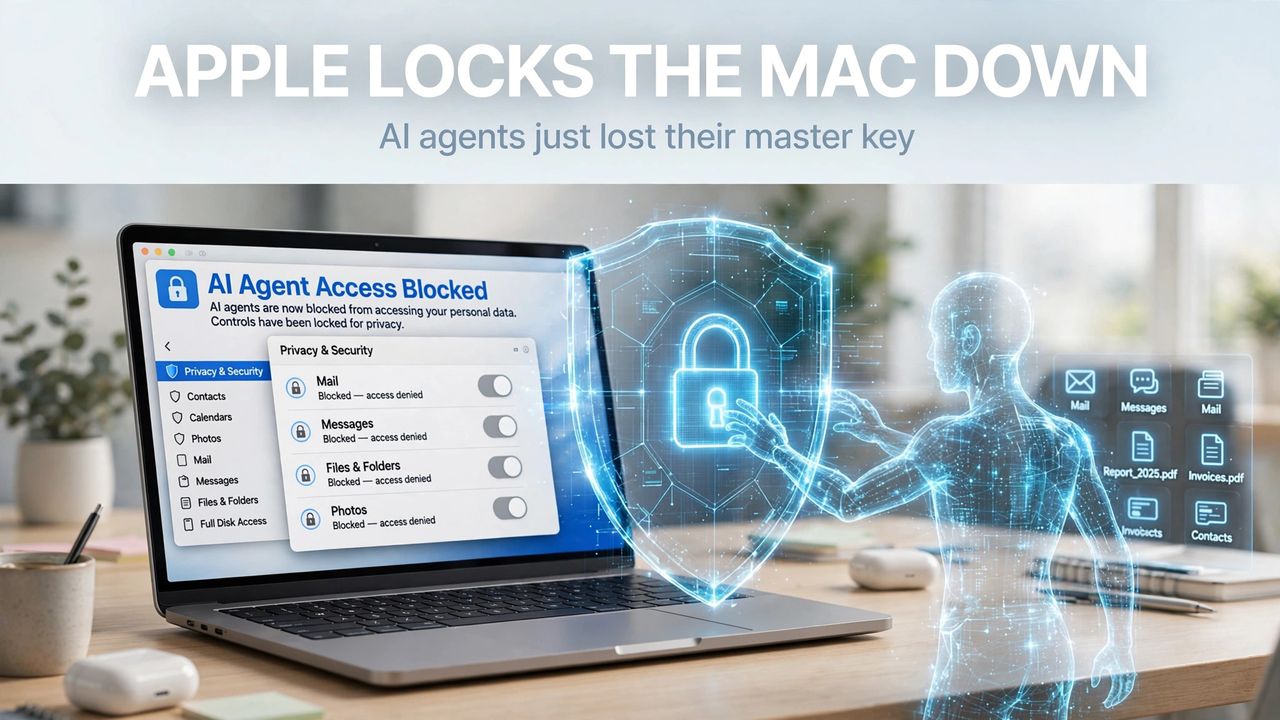
On Friday, October 2, Apple posted a statement on its developer news site, \"Updates to Full Disk Access in macOS,\" announcing new controls on macOS's \"Full Disk Access\" permission. Apple says that as AI agents grow more capable and autonomous, the risks tied to this level of access \"will grow substantially\" — and going forward, users who genuinely want to grant it will be able to do so only through \"very explicit user action.\"
Related
- 01
UK's ICO Names 10 AI Labs in Training-Data Privacy Crackdown: "No Justification" for Non-Compliance
- 02
Google Launches Universal Work Agent Gemini Agent, Running Gemini and Anthropic's Claude
- 03
Apple Signs Hiring and Licensing Deal With AI Podcast Startup Huxe — Not an Outright Acquisition
- 04
Manus Parent Raises Over $500M, Operating Independently After Meta Deal Was Blocked
What Happened
Apple's statement names no developer. Days earlier, Inc. columnist Jason Aten reported that Meta's Muse agent — launched September 8 — had synced more than 187,000 of his private messages on the Mac, while he says he explicitly declined to give Muse access to his messages or calendar. When he asked Muse, it first said it only saw the "incoming notification stream" — before he discovered it had read the Mac's local Messages database directly. Meta spokesperson Andy Stone pushed back on X, saying both Full Disk Access and the Messages connector must be enabled for Muse to read messages — "It can't read your Messages unless you do this. And it can be revoked at any time."
Separately, Wired reported a flaw in ChatGPT's Mac app that could have let hackers access sensitive data. Apple's statement says: "Some developers are using Full Disk Access in ways that could put users at risk" — and "for communication apps, this can also compromise the privacy of the people users are communicating with."
Key Facts
- Apple's move: New controls on macOS Full Disk Access, grantable only through \"very explicit user action\"; no timeline or macOS version announced, and no developer or app named.
- Key quotes: \"Some developers are using Full Disk Access in ways that could put users at risk, exposing everything on their systems without users' full knowledge and understanding.\" And: \"As AI agents become increasingly capable and autonomous, the risks associated with this level of access will grow substantially.\"
- The permission: Full Disk Access was built for backup software; it bypasses macOS's normal privacy protections to read files, mail, messages and browsing history. When communication apps are swept up, even the user's contacts get exposed.
- Related events: Meta's Muse was accused of syncing 187,000+ private messages (Meta disputes, saying reading messages needs dual opt-in and can be revoked); Wired reported a ChatGPT Mac app flaw that could leak sensitive data.
Context
Full Disk Access was designed for tools like backup software and disk utilities. Since always-on desktop AI agents (Meta's Muse, OpenAI's dots) arrived, more developers ask for the same permission — one grant, and an agent can keep reading the whole machine.
Why it matters
Apple says that as AI agents become more capable and autonomous, the risks of this access "will grow substantially"; it gave no timeline or macOS version for the new controls and named no developer or app.
Comments
Today
Oct 12 Monday- Brief
- Quiz
- Call
Latest news
All →- Oct 12text-to-cad Hits GitHub Weekly Chart: CAD Skills for Agents
- Oct 12colibri Hits GitHub Trending: Pure-C Engine Runs a 744B Model on Ordinary PCs
- Oct 12Moonshot Executives Reported in Settlement Talks With Shareholder, Claim Tops $700 Million
- Oct 11Amazon in Talks to Buy AI Startup Decart in Deal Valued Around $7 Billion
- Oct 11GSK Expands Chai Deal After Wet-Lab Validation of AI Designs
- Oct 11PPT Master Hits GitHub Trending: Documents Become Native PowerPoint