 ™
™Microsoft Ships Its Own Voice Stack: 60-Language Streaming Transcription + Seconds-Level Voice Cloning
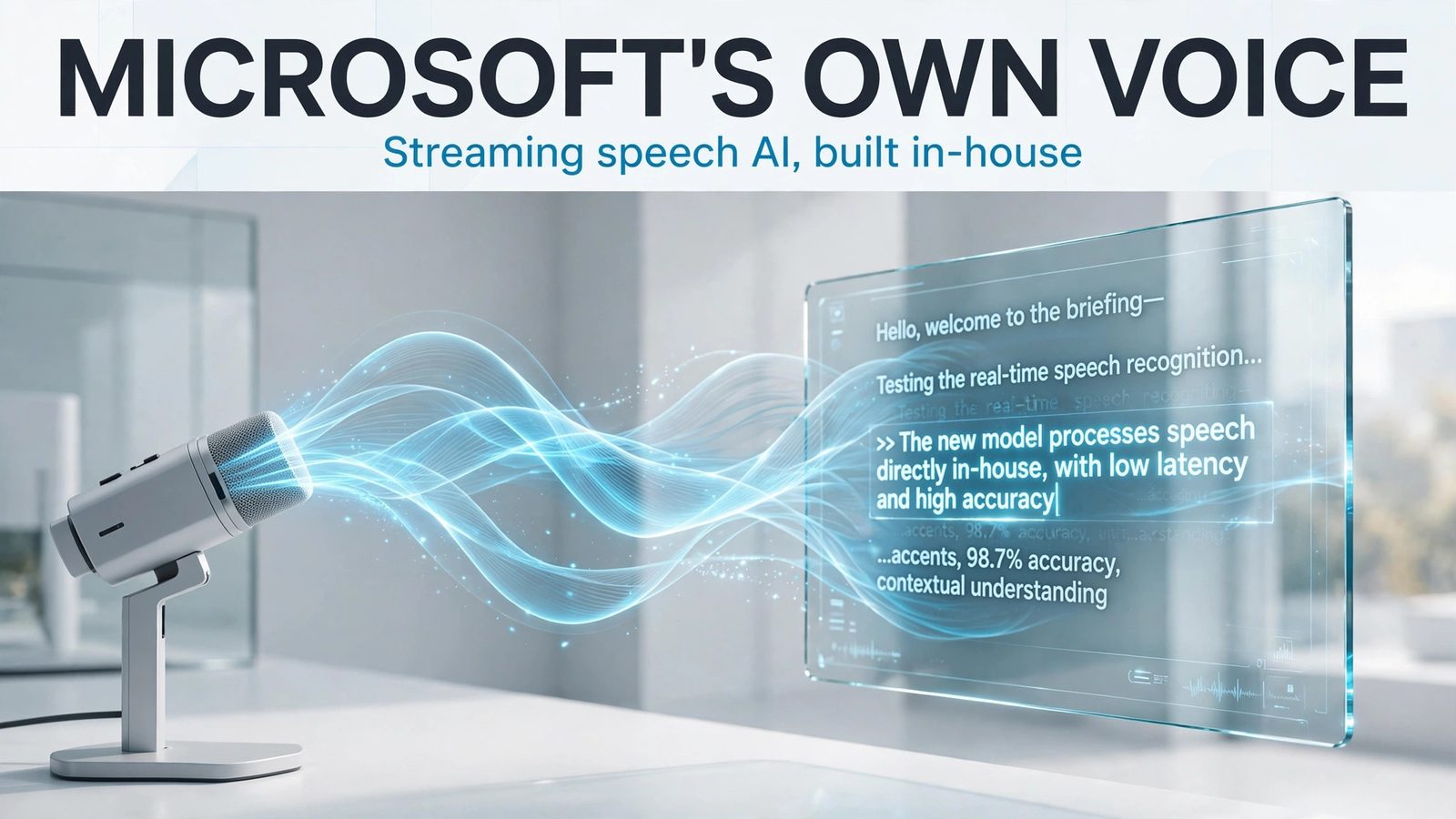
On October 1, the Microsoft AI official blog launched a homegrown voice model stack: streaming transcription model MAI-Transcribe-2-Streaming supports 60 languages with first-word latency of about 100 milliseconds, which Microsoft claims ranks #1 on Artificial Analysis accuracy benchmarks; the simultaneously released MAI-Voice-2.1 and Flash text-to-speech models clone a voice from just seconds of reference audio.
What Happened
On October 1, Microsoft AI unveiled three homegrown voice models on its official blog microsoft.ai: streaming transcription model MAI-Transcribe-2-Streaming, plus two text-to-speech models, MAI-Voice-2.1 and MAI-Voice-Flash, covering both speech recognition and speech synthesis.
The transcription model is all about real time: 60 languages, continuous automatic language detection, ~100ms first-word latency, priced at $0.54 per audio hour (promotional price this year). Microsoft claims it ranks #1 on Artificial Analysis for both final and partial transcription accuracy. On the TTS side, MAI-Voice-2.1 covers 23 languages and 26 regions, with same-speaker cross-language support that keeps local accents ($22 per million characters); the Flash edition pushes latency down to 150ms ($15 per million characters). Voice cloning needs only seconds of reference audio, but requires approval and ships with consent safeguards.
Key Facts
- When & where: October 1, 2026, first published on the Microsoft AI official blog (microsoft.ai); covered consistently by The Decoder, RuntimeWire, TestingCatalog, and WindowsReport.
- Transcription: MAI-Transcribe-2-Streaming: 60 languages, continuous automatic language detection, ~100ms first word; Microsoft claims #1 on Artificial Analysis final/partial transcription accuracy; $0.54/audio hour (promotional price this year).
- Speech synthesis: MAI-Voice-2.1: 23 languages / 26 regions, same-speaker cross-language with local accents, $22 per million characters; Flash edition: 150ms latency, $15 per million characters.
- Voice cloning: Clones a voice from seconds of reference audio; requires approval and includes consent safeguards.
Context
OpenAI had already launched its Realtime API and TTS models. Microsoft's three new models are all built in-house, with no outside models.
Why it matters
All three transcription and speech models are built in-house by Microsoft; transcription has ~100ms first-word latency at $0.54 per audio hour, and the Flash TTS model runs at 150ms latency for $15 per million characters.
CompaniesMicrosoft
Comments
Related
- Oct 8Google Launches Universal Work Agent Gemini Agent, Running Gemini and Anthropic's Claude
- Oct 10Microsoft Launches Decision-1, a Decision Model That Outputs Calibrated Probabilities, Not Text
- Oct 11Nadella Calls for an 'Emergency Brake' on AI Models: Assume Compromise, Let Humans Hit Stop
- Oct 9UK's ICO Names 10 AI Labs in Training-Data Privacy Crackdown: "No Justification" for Non-Compliance
- Oct 8USA Today Sues OpenAI: $250M+ Damages Sought, "Hundreds of Thousands" of Articles Allegedly Taken for Training
Today
Oct 12 Monday- Brief
- Quiz
- Call
Latest news
All →- Oct 12Hands-On: Perplexity pplx-embed-v2-late — the 0.6B Model That Queries a 9B Index
- Oct 12Moonshot in Settlement Talks Before Its IPO: A Claim Above $700 Million Dating to a Spin-Out
- Oct 12text-to-cad Hits GitHub Weekly Chart: CAD Skills for Agents
- Oct 12colibri Hits GitHub Trending: Pure-C Engine Runs a 744B Model on Ordinary PCs
- Oct 12Moonshot Executives Reported in Settlement Talks With Shareholder, Claim Tops $700 Million
- Oct 11Amazon in Talks to Buy AI Startup Decart in Deal Valued Around $7 Billion