
Utah Approves Nolla Health's AI to Write First-Time Prescriptions: A U.S. First, $4.99/mo
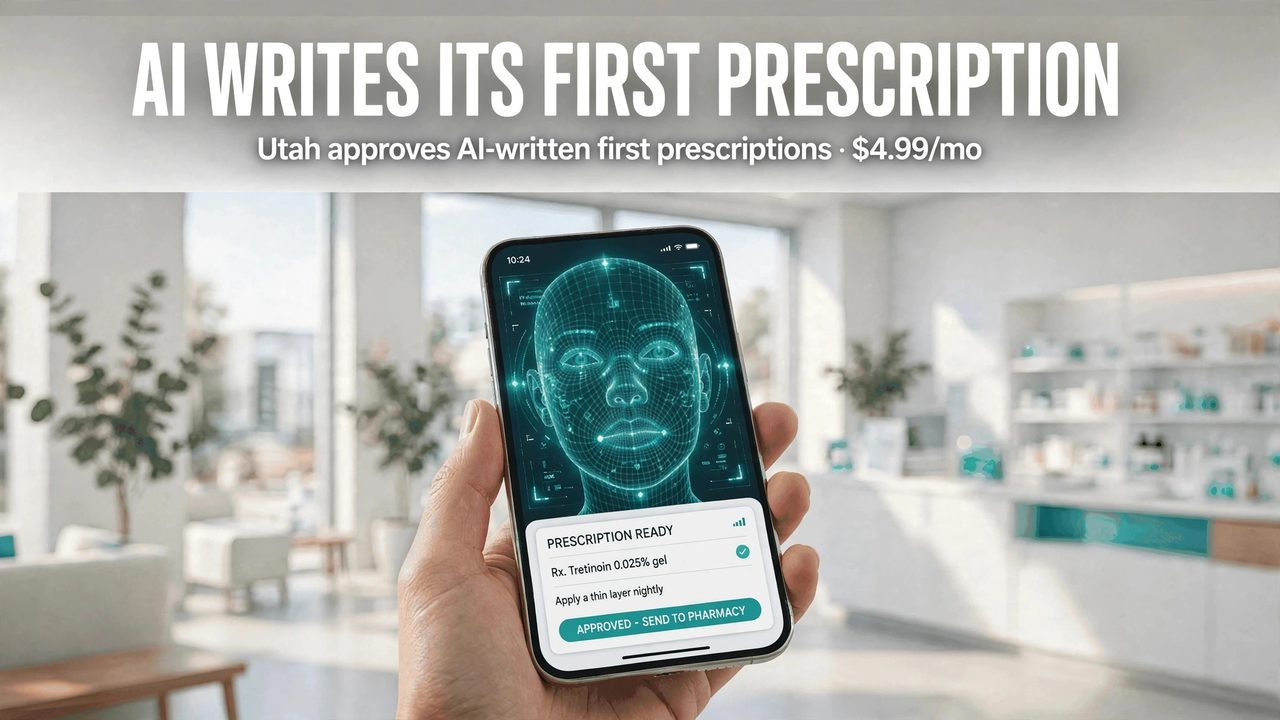
On Monday, October 5, New York startup Nolla Health announced that its AI has received Utah regulatory clearance to issue "initial prescriptions" for patients — note: not refills, but first-time prescriptions. Per Bloomberg Law and STAT, this is the first US regulatory approval allowing AI to independently write new prescriptions. The pilot runs through the Nolla Derm app for mild-to-moderate acne in Utah residents 18 and older: a face scan plus a 10-to-15-minute questionnaire, and a personalized treatment plan and prescription in minutes — $4.99/month, no clinic visit, no waiting list.
What Happened
The clearance comes from two agencies under the Utah Department of Commerce: the Office of Artificial Intelligence Policy (OAIP) and the Division of Professional Licensing. They signed an agreement with Nolla's operating entity, Magic Health — on September 22 the pilot appeared on the state's public list of authorized AI pilots. The core of the agreement is a non-enforcement promise: the state agrees not to pursue unlicensed-practice or telehealth violations for AI-issued first-time topical acne prescriptions. But the fine print is explicit: this is a grant of regulatory mitigation only, not an endorsement by the State of Utah. The pilot runs 12 months, renewable for two more years.
Here's the flow: patients download the Nolla Derm app, verify identity, complete informed consent, fill a 10-to-15-minute intake questionnaire, then take a five-angle face scan. The AI analyzes the skin, scores oiliness and acne severity (from clear to severe), combines it with medical history, and picks a medication from a physician-preapproved list. Nolla stresses the difference from telehealth platforms: those use AI to collect information and hand off to a clinician for the actual prescription; its system independently issues initial prescriptions within tightly defined, physician-approved treatment protocols. Bloomberg Law, STAT, Medical Economics, Becker's Hospital Review and MobiHealthNews all covered the launch the same day.
Key Facts
- Why acne: a 61-day wait vs $4.99/month: Nolla's numbers: only about 10% of Utahns with acne ever see a dermatologist, and the average appointment wait is 61 days. The app subscription is $4.99/month; compounded medications run about $50/month (meds billed separately). Per Becker's, the Nolla app has been downloaded more than 175,000 times across 44 states — but this pilot is open only to Utah adults 18 and older.
- Scope: 8 topical treatments: The AI can only choose from 8 pre-approved topical treatments. Oral medications and isotretinoin (Accutane) are explicitly excluded; severe acne and other unsuitable cases get screened out and routed to a licensed physician. If the AI can't confidently pick a treatment, the patient goes to a human doctor — this is written into the agreement.
- Physician oversight phases down in three stages: every Rx → daily → weekly: First 100 patients: two Utah-licensed physicians approve every AI-generated prescription before it goes out. Through patient 500: the AI prescribes on its own, physicians review its decisions daily after the fact. After that: physicians review a weekly sample of at least 10%. Nolla says clinicians agreed with the AI's recommendations in more than 96% of real-world cases, the rest needing only minor dose or strength tweaks — note: that's the company's own claim, not independently verified.
- Utah's earlier AI prescribing pilots were refills only: Utah's OAIP is the country's first AI regulatory sandbox. It had already cleared AI prescribing pilots for Doctronic (refills for nearly 200 chronic-condition medications) and Legion Health (psychiatric-drug refills) — both refills of drugs a doctor had already prescribed. This is the first time AI may write a prescription from scratch. The earlier Doctronic pilot drew criticism from physicians over the lack of real consultation.
- Founder's claim vs the approved scope: Founder Luis Wenus (ex-Worldcoin) called it the "first ever end-to-end AI doctor" on X. The approval covers one state, one condition, 8 topical drugs and a 12-month regulatory waiver; the company raised $4.5M last year (including General Catalyst). Nolla plans to extend AI prescribing to more conditions, and each step needs new regulatory approval.
Context
Writing a prescription carries diagnostic responsibility, and in every US state that responsibility rests with a licensed physician. Telehealth platforms have used an "AI intake + doctor approves" model. Utah's OAIP sandbox lets the state waive regulations for specific AI products, using a non-enforcement promise in place of unlicensed-practice enforcement; the agreement also makes malpractice coverage and a board-appointed physician Nolla's responsibility, with no endorsement or liability from the state.
Why it matters
Per Bloomberg Law and STAT, it is the first US regulatory approval letting AI independently write new prescriptions, not refills; it is limited to mild-to-moderate acne in Utah adults and 8 pre-approved topical treatments.
Comments
Today
Oct 12 Monday- BriefAmazon in Talks to Buy AI Startup Decart in Deal Valued Around $7 Billion
10 stories · Oct 11
- Quiz
- Call
Latest news
All →- Oct 11Amazon in Talks to Buy AI Startup Decart in Deal Valued Around $7 Billion
- Oct 11GSK Expands Chai Deal After Wet-Lab Validation of AI Designs
- Oct 11PPT Master Hits GitHub Trending: Documents Become Native PowerPoint
- Oct 11context-mode Hits GitHub Trending: Tool Output, Sandboxed First
- Oct 11Cloudflare Acquires Deno: Deploy Shuts Down in Six Months
- Oct 11Anthropic Updates Claude Usage Policy: Armed Drones Named and Banned, Effective Nov 12