
OpenAI Launches textGrain Text Watermarking, Auto-Applied to ChatGPT and Codex in the EU
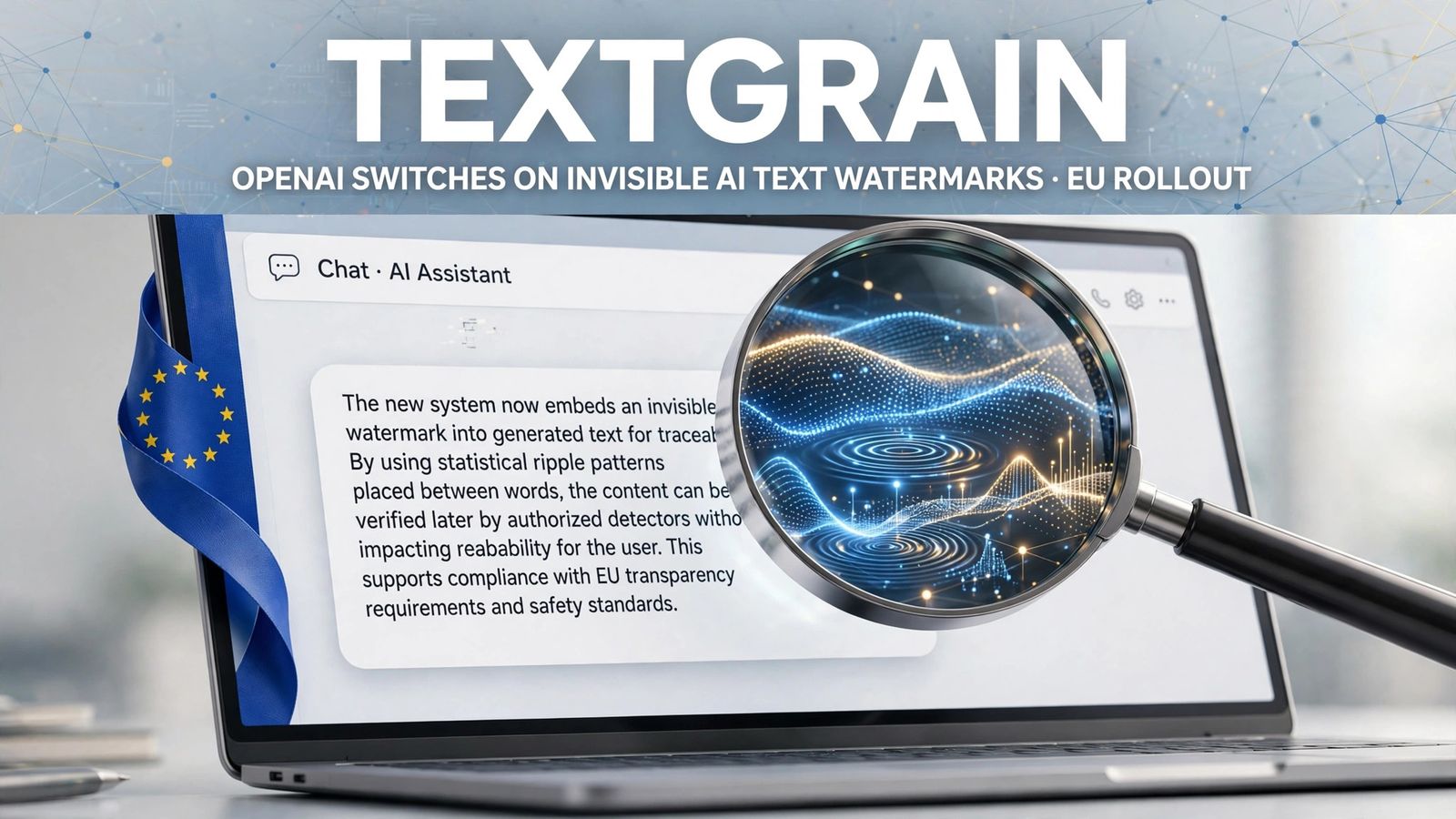
On Monday, October 5, OpenAI announced textGrain — an invisible statistical watermarking technology. It hides no characters in the text; instead, a secret key nudges the ranking of word choices as the model generates, and hundreds of innocuous-looking tweaks add up to a statistical signal only the key holder can read. Starting today, eligible ChatGPT and Codex users in the European Union will get the watermark automatically over the coming weeks (all plans); API customers anywhere can opt in for select models — but it's off by default. The tech was developed with researchers from the University of Pennsylvania and Yale; a technical report is out, and OpenAI says it will open-source textGrain.
What Happened
OpenAI laid out its EU text-provenance plan on the company blog Monday. Two tracks in parallel: from today, API customers anywhere can opt in to textGrain watermarking for select models — off by default, you have to turn it on yourself; over the coming weeks, eligible ChatGPT and Codex users (eligible users, all plan tiers) inside the European Union will get the watermark automatically. Outside the EU, ChatGPT gets no watermark, and it won't become a global default at launch. The detector won't be public: only approved researchers and expert organizations get it, which OpenAI says is to evaluate reliability and responsible use before anything wider.
How it works: textGrain adds no hidden characters — a secret key nudges the ranking of candidate words at each generation step; each choice looks like normal prose, but hundreds of tiny nudges accumulate into a statistical pattern that a detector holding the key can spot. Because the mark lives in the wording itself, copy-paste carries it along and can't strip it. OpenAI says its internal tests matched or beat other approaches it tried, including Google's SynthID, and it plans to open-source textGrain. TechCrunch, Neowin, 9to5Mac and the OpenAI developer community confirmed the announcement the same day.
Key Facts
- Scope: automatic in the EU, opt-in everywhere else: EU: eligible ChatGPT and Codex users get the watermark automatically over the coming weeks, across all plans. Outside the EU: no watermark on ChatGPT, and no global default at launch. API: customers worldwide can opt in for select models starting today, off by default. The detector goes only to approved researchers and expert organizations — the public and copyright holders don't get the key.
- What it proves — and what it doesn't: The watermark can only indicate that 'an OpenAI system generated or processed part of a passage.' It can't tell you who used the system, how much a person contributed, who owns the text, or whether the content is accurate. The reverse holds too: no watermark detected doesn't prove a human wrote it — the text might be too short, heavily edited, or from another company's model. OpenAI put these caveats in the announcement itself.
- OpenAI's own admitted failure modes: four of them: Short passages (not enough signal), math content (too little room for word-choice nudges), translation, and substantially edited text all make detection substantially less reliable. Neowin's headline said the watermark is "not hard to remove."
- The timeline: compliance deadline December 2: The EU AI Act's Article 50 transparency obligations took effect on August 2, 2026: generative AI outputs must carry machine-readable marking. In July 2026 the EU published guidelines and roughly 190 vendors signed the Code of Practice on transparency (Anthropic, Google, Meta, Microsoft and OpenAI all on it); legacy systems placed on the market before August 2 have until December 2, 2026 to comply. OpenAI's rollout comes ahead of that deadline.
- A watermark built two years ago: The Wall Street Journal reported in 2024 that OpenAI had a text watermark built two years earlier, rated about 99.9% effective internally, but did not ship it over fears users would move to rivals that didn't watermark. Elsewhere: Google's SynthID text watermarking has been in Gemini since 2024 (method published in Nature); Anthropic switched on worldwide watermarking for Claude in August, drawing user objections ('I supplied the instructions, context, decisions — Claude was just the tool'); China's AI-content labeling rules took effect in September 2025.
Context
Google's SynthID has marked Gemini's text output since 2024 (method published in Nature); Anthropic's August launch of worldwide Claude watermarking drew user complaints that the words were theirs to own. NIST's US report on synthetic-content risk treats watermarking and provenance data as the main tools for authenticating synthetic media while noting their limits; the bills in Congress that would standardize it focus on deepfake election manipulation and fraud. Anthropic, Google, Meta, Microsoft and OpenAI have all signed the EU transparency code.
Why it matters
Eligible ChatGPT and Codex output in the EU will be watermarked automatically within weeks; the AI Act deadline for systems on the market before August 2 is December 2.
CompaniesOpenAI
Comments
Today
Oct 12 Monday- BriefAmazon in Talks to Buy AI Startup Decart in Deal Valued Around $7 Billion
10 stories · Oct 11
- Quiz
- Call
Latest news
All →- Oct 11Amazon in Talks to Buy AI Startup Decart in Deal Valued Around $7 Billion
- Oct 11GSK Expands Chai Deal After Wet-Lab Validation of AI Designs
- Oct 11PPT Master Hits GitHub Trending: Documents Become Native PowerPoint
- Oct 11context-mode Hits GitHub Trending: Tool Output, Sandboxed First
- Oct 11Cloudflare Acquires Deno: Deploy Shuts Down in Six Months
- Oct 11Anthropic Updates Claude Usage Policy: Armed Drones Named and Banned, Effective Nov 12