 ™
OpenAI Publishes Data Center Community Compact: Pays Its Own Power Bills, Discloses Water Use, Drops NDAs
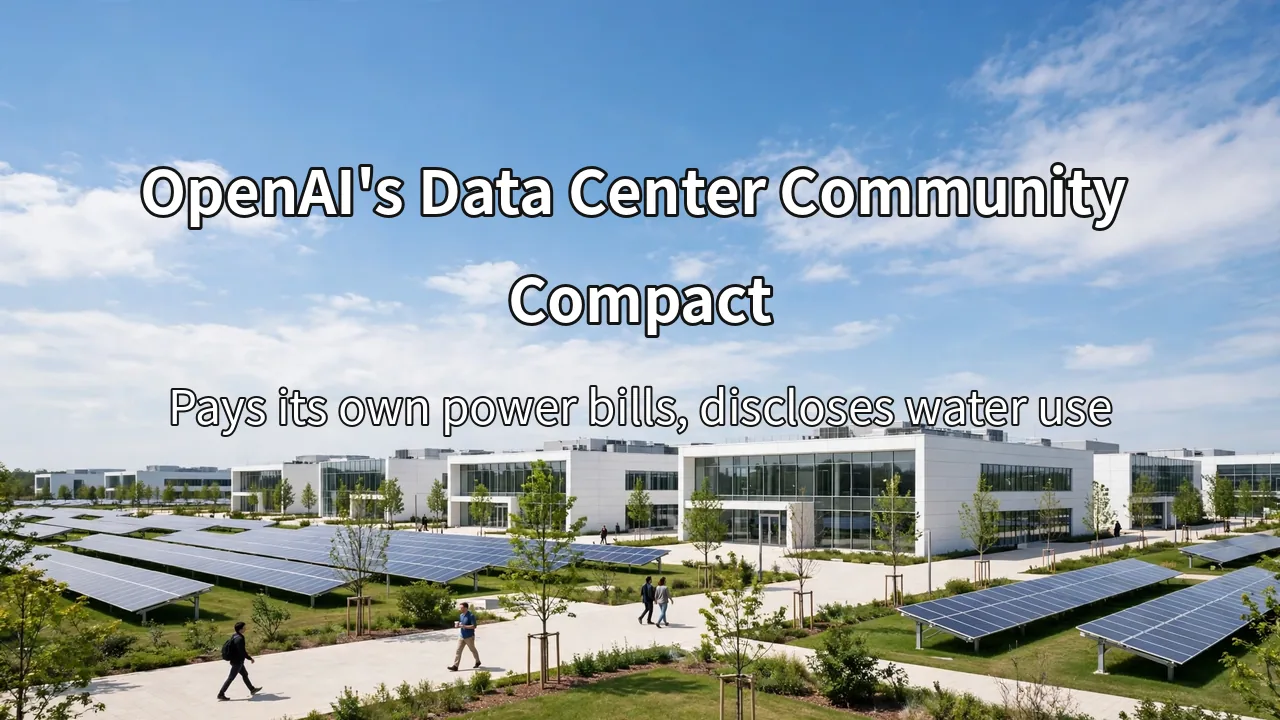
OpenAI published a National Community Compact and a Compute Campus Policy Blueprint on Nov 5, pledging that campuses it owns and operates will pay the full cost of their electricity, publish water and power use, and stop asking public officials to sign NDAs.
What happened
The two documents came out two days after the Nov 3 midterm elections. According to reports, 40 of 41 local data-center restriction measures passed, and the governor-elects in Texas and Georgia favor pausing new data-center construction. OpenAI's post does not mention the election, calling the compact the next step after its January Stargate Community commitments, with specific commitments already made in Georgia and Ohio. Chief global affairs officer Chris Lehane told Axios on Nov 1 that a policy push would follow the election, and that AI would be the number-one issue of the 2028 presidential election.
The compact applies only to campuses OpenAI owns and operates. Each future campus gets its own local compact, shaped with residents' input, with a local point of contact and an annual public progress report. On energy, the company pledges to pay the full cost of the electricity it uses and the grid infrastructure needed to serve it, and to provide financial assurances before major spending so other customers are not left with the bill if a project is delayed, reduced or canceled. Each campus gets a water plan, with closed-loop or low-water cooling preferred in dry areas, and site-level water and electricity use, construction plans and independent noise studies are published. The company will not require public officials to sign NDAs as a condition for discussion or negotiation, with narrow exceptions for security information, trade secrets or proprietary information; it voided its NDAs in Effingham County, Georgia, in July. On jobs, each site publishes a workforce plan and reports hiring and apprenticeship figures each year, with local hiring targets where conditions allow.
The blueprint pushes the same set of rules toward legislation. It asks state utility commissions to make large electricity users cover the grid costs they add and to protect other customers if a project falls through; to bar developers from requiring officials to sign NDAs; to require public reporting on water, energy, noise and hiring; and to make tax-incentive deals public, with measurable commitments and a way to recover benefits if a developer falls short. Congress is asked to speed up transmission upgrades and restore and expand clean-electricity tax credits. Figures for the two named counties: Effingham County gets an $80 million commitment, including a $4.8 million grant for free school meals for all 14,000 students in the county and $2 million for a park; land-sale money plus a state grant has cut property tax by about 30% on average for qualifying homeowners, and OpenAI says it will pay at the old, higher rate; its deal with Georgia Power lets the utility cut up to 1,000 megawatts of supply to the campus at peak demand. Pike County gets a $40 million commitment, including $6 million for childcare shared with SB Energy; the company expects the campus to create 2,500 long-term jobs paying $80,000 a year on average and 26,000 construction jobs.
Key facts
- Publisher and date: OpenAI, Nov 5, 2026; the National Community Compact and the Compute Campus Policy Blueprint
- Scope: only campuses OpenAI owns and operates; each future campus gets its own local compact shaped with residents, with a local contact and an annual public report
- Power bills: full payment of the electricity used and the grid infrastructure needed to serve it; financial assurances before major spending, so other customers are not left with the bill if a project is delayed, reduced or canceled
- NDAs: no longer required of public officials as a condition for discussion or negotiation, with narrow exceptions for security information, trade secrets or proprietary information; NDAs in Effingham County were voided in July
- Public figures: site-level water and electricity use, construction plans and independent noise studies are published; each campus gets a water plan, with closed-loop or low-water cooling preferred in dry areas
- Jobs: each site publishes a workforce plan and reports hiring and apprenticeship figures each year, with local hiring targets where conditions allow
- Effingham County: an $80 million commitment, including $4.8 million for free school meals for 14,000 students and $2 million for a park; the Georgia Power deal allows up to 1,000 megawatts to be cut at peak demand
- Pike County: a $40 million commitment, including $6 million for childcare shared with SB Energy; the company expects 2,500 long-term jobs at $80,000 a year on average and 26,000 construction jobs
- Blueprint's legislative asks: state utility commissions make large users cover added grid costs; developers barred from requiring NDAs; mandatory reporting on water, energy, noise and hiring; tax-incentive deals public with clawbacks; Congress to speed transmission upgrades and restore clean-electricity tax credits
- Limits: the commitments are voluntary, checked by the company itself in annual reports; the documents do not say which existing sites count
Why it matters
40 of 41 local data-center restriction measures passed in the midterms, and OpenAI promptly put power bills, water use and NDAs into written commitments, while pushing legislation to make the same rules apply industry-wide.
CompaniesOpenAI
Follow HIMIAO Horizon
No sign-up · Unsubscribe any timeNotifications
A ping on your phone or computer when the brief is out. No email needed.
Comments
Related
- Oct 31Wikimedia Foundation Weighs In on NYT v. OpenAI: Split Training From Chatbot Answers
- Oct 30Four AI Labs Back a Shared Training Opt-Out Signal
- Oct 25Sweden's Government Offices Block ChatGPT and Claude on Work Computers From Oct 26
- Oct 24Texas Sues OpenAI and Altman: the Tenth State Suit, and the CEO Is a Defendant
- Oct 24Texas AG Sues OpenAI and Altman, Alleging ChatGPT Deceived Consumers and Harmed Minors
Today
Nov 6 Friday- Brief
- GitHubGitHub Weekly Vol.4: 6 Projects Worth a Look This Week
Tested or read — weeklyAll →
- Quiz
- Call
Latest news
All →- Nov 6OpenAI Agents Find 948 Linux Kernel Root Flaws in One Run, Each With a Working Exploit and Patch
- Nov 5Claude Helps Map First 3D Structure of a Bacterial Vault Particle: 96 Protein Copies Form a Hollow Shell
- Nov 5Ricursive Launches Ripple-65B Preview: 65B Open Model Claims Lead Among US Peers in Coding
- Nov 5Moonshot Releases Full Kimi K3.1 Pro Weights: 2.8T Parameters, About 1.56 TB
- Nov 5Tencent Hy4 vs Mistral Large 4: Open-Weight Flagships a Week Apart, One's Weights Out and the Other's Pending, Output Prices $0.401 Apart
- Nov 5Oracle Cancels $7B Tencent Chip Lease as Pressure From Both Sides Ends Remote-Compute Deal