 ™
TopicNVIDIA Cosmos 3 World Models
NVIDIA Releases Four Cosmos 3 World Models: 16B Open Weights for Driving and Robot Simulation
NVIDIA released four open-weight Cosmos 3 checkpoints on Hugging Face on Nov 5, all post-trained versions of the 16B-parameter Cosmos 3 Nano under the commercially permissive OpenMDW1.1 license.
What happened
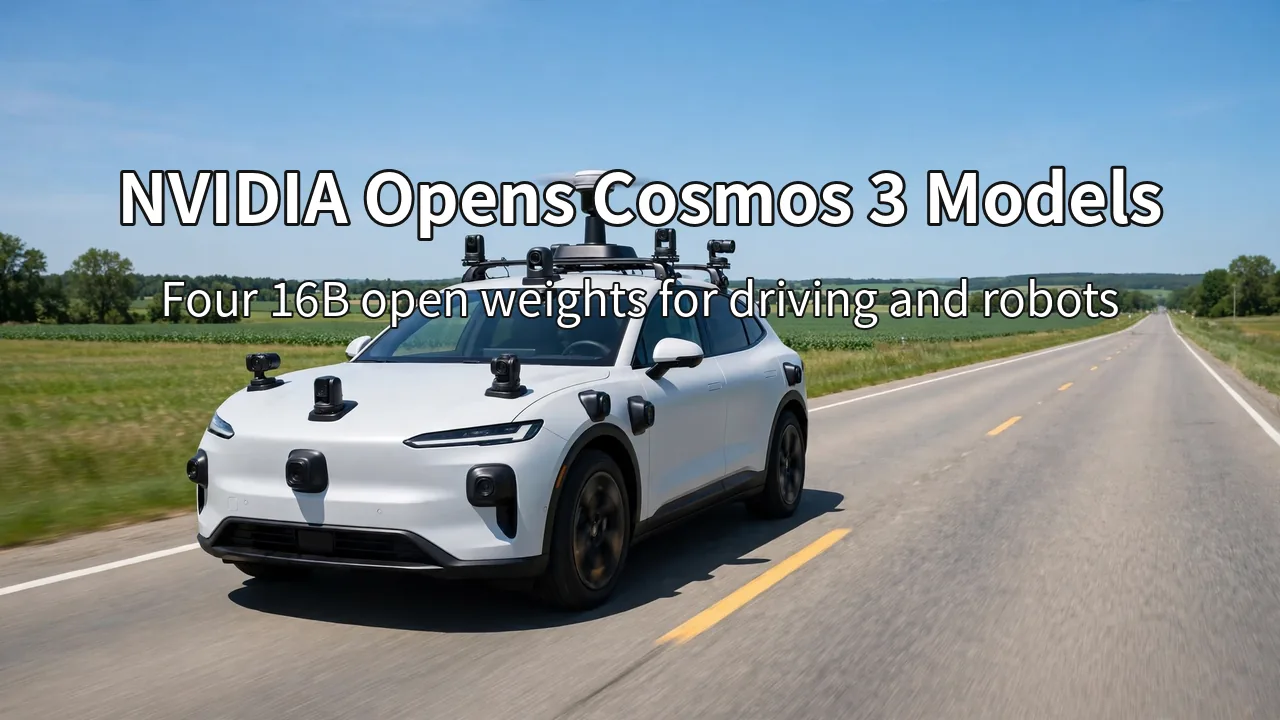
The four checkpoints split by simulation task. Transfer-Auto targets offline driving data generation, producing synchronized video across up to 11 camera views, including fisheyes, plus LiDAR point clouds; developers set road layout and traffic behavior with per-camera World Scenario Map controls and steer appearance with text prompts. Sim-Auto is the causally distilled streaming variant of Transfer-Auto, generating successive small chunks of synchronized camera video and LiDAR for long interactive rollouts.
The other two target robotics. Sim-Transfer turns a physics simulator's controls and a text prompt into photorealistic RGB video, using four spatial controls — depth, segmentation, edges and blur — while the simulator keeps the physical state and text guides appearance. Sim-Bimanual predicts the next video frame from bimanual robot or camera actions, supporting interactive two-arm simulation for the YAM and AgiBot embodiments; one control sequence can switch between viewpoint changes and manipulation, and the mixed-action example uses 59 control values.
NVIDIA also published the four-stage training recipe — bidirectional adaptation, teacher forcing, consistency distillation and self-forcing, with the final stage training on the model's own generated history to slow error accumulation — alongside the post-training recipes so developers can adapt the models to their own sensor rigs and embodiments. NVIDIA's technical blog of Nov 2 frames the platform as serving autonomous driving, robotics and smart infrastructure, and the company hosted a Cosmos Labs livestream on Nov 5; NVIDIA also says researchers still need to measure whether the models reliably support policy learning and evaluation.
Key facts
- Publisher and date: NVIDIA, Nov 5, 2026; the checkpoints were published on Hugging Face, with the technical blog posted Nov 2
- The four checkpoints: Cosmos3-Nano-Transfer-Auto, Cosmos3-Nano-Sim-Auto, Cosmos3-Nano-Sim-Transfer and Cosmos3-Nano-Sim-Bimanual, all post-trained versions of Cosmos 3 Nano
- Parameters: each has 16 billion trainable parameters; the backbone is a Mixture-of-Transformers, connecting text-processing and visual-generation networks through attention
- License: OpenMDW1.1, permitting commercial and non-commercial use under its terms
- Transfer-Auto: offline synthetic driving data, generating synchronized video across up to 11 camera views including fisheyes, plus LiDAR point clouds; per-camera World Scenario Map controls set road layout and traffic behavior
- Sim-Auto: the causally distilled streaming variant of Transfer-Auto, generating each small chunk of synchronized camera video and LiDAR in a few denoising steps for long interactive rollouts
- Sim-Transfer: simulator controls plus a text prompt become photorealistic RGB video; depth, segmentation, edge and blur spatial controls keep the physical state in the simulator
- Sim-Bimanual: predicts the next video frame from bimanual robot or camera actions; supports YAM and AgiBot embodiments, controlled by a policy or human-operated joysticks; the mixed-action example uses 59 control values
- Training recipe: four stages — bidirectional adaptation, teacher forcing, consistency distillation and self-forcing; post-training recipes and inference weights are released together for adaptation to new sensor rigs and embodiments
- Requirements and limits: running the models requires Linux, an NVIDIA GPU, Docker and the NVIDIA Container Toolkit; NVIDIA says it remains to be measured whether the models reliably support policy learning and evaluation
Why it matters
four 16B open weights hand driving and robot simulation to the open-source community — 11-camera views plus synchronized LiDAR generation previously lived mostly inside closed systems — but NVIDIA also says it remains to be measured whether the models reliably support policy training and evaluation.
CompaniesNVIDIA
Follow HIMIAO Horizon
No sign-up · Unsubscribe any timeNotifications
A ping on your phone or computer when the brief is out. No email needed.
Comments
Related
- Nov 7NVIDIA Releases Four Cosmos 3 Open Weights: 16B World Models for Driving Data and Robot Simulation
- Oct 26NVIDIA Nemotron 3.5 Bolt E4B Review: A Local Agent in 4GB of VRAM
- Oct 24NVIDIA Releases Nemotron 3.5 Bolt E4B: Local Agents on 4GB of VRAM
- Oct 22DeepSeek Open-Sources DeepInfer, the Inference Engine Behind Its Production Services
- Oct 20doubleAI Launches "Code Execution Model" Maxwell With Nvidia Backing; First Customer Cut Compute Costs 67%
Today
Nov 8 Sunday- Brief
- GitHubGitHub Weekly Vol.4: 6 Projects Worth a Look This Week
Tested or read — weeklyAll →
- Quiz
- Call
Latest news
All →- Nov 8OpenAI Launches BioBasicsBench: GPT-6 Astra Scores 66.7% on Wet-Lab Tasks but Still Misreads Experiments
- Nov 8Meta Brings Wonder-Trained Specialized Models to Muse and Meta AI
- Nov 7Anthropic IPO Valuation Talk Falls to $1.1–$1.3 Trillion as Roadshow Nears
- Nov 7OpenAI Said to Close First $11 Billion at $1.25 Trillion Valuation
- Nov 7DeepMind Agents Find Two Weaknesses in Legacy 1024-Bit RSA
- Nov 7Microsoft Is Said to Wind Down Oracle AI Cloud Rental as Older Chips No Longer Fit