 ™
OpenAI Launches BioBasicsBench: GPT-6 Astra Scores 66.7% on Wet-Lab Tasks but Still Misreads Experiments
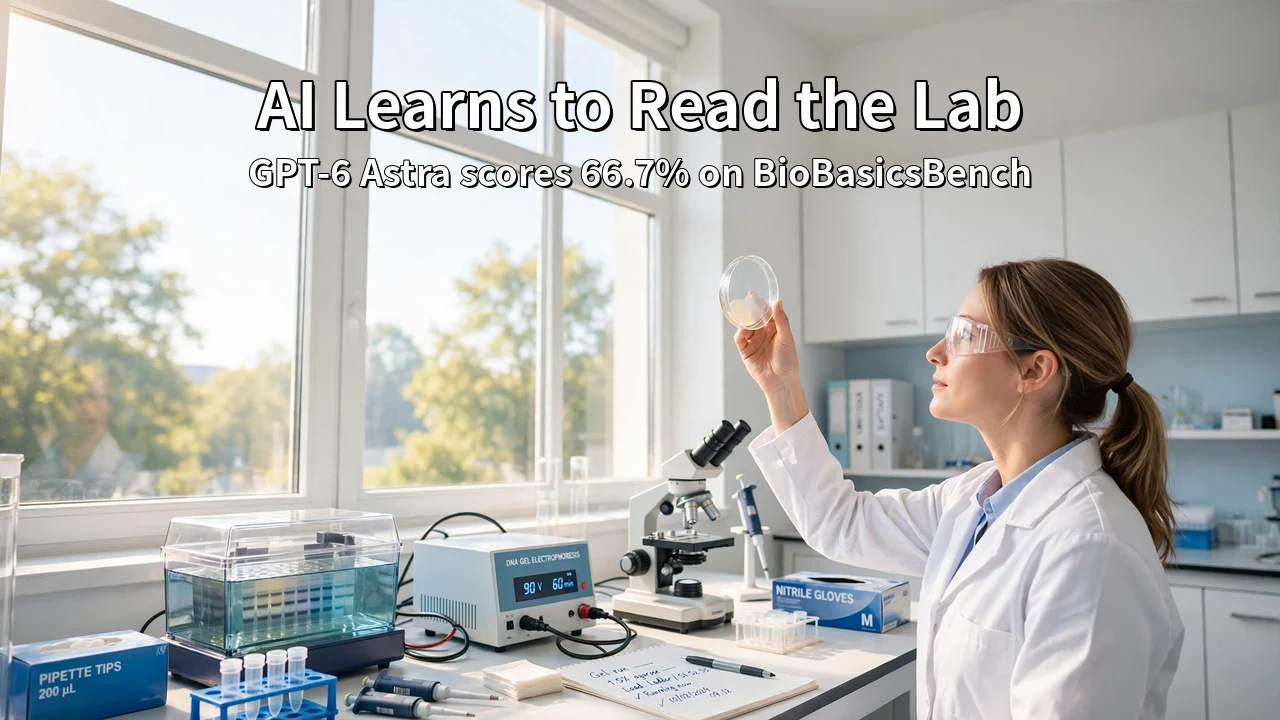
OpenAI released BioBasicsBench on Nov 6, a 100-task wet-lab benchmark built with enzyme-design company Ligo to test whether AI agents can read raw experimental data; GPT-6 Astra averaged 66.7% of available credit, above GPT-5.6 Sol's 43.8%.
What happened
Everyday wet-lab work involves failed experiments, ambiguous images, and conflicting observations, and OpenAI said in its official blog that existing benchmarks, built around charts and images selected for scientific papers, can miss that ambiguity and the troubleshooting it requires; with enzyme-design company Ligo, it launched BioBasicsBench to measure how well agents handle routine wet-lab analysis.
The benchmark has 100 tasks across five areas of routine wet-lab work: protein methods, imaging and cytometry, quantification and assays, nucleic acid methods, and molecular cloning; tasks use raw evidence such as gel and blot images, colony plate photos, microscopy images, sequencing reads, instrument exports, and even videos of bench work, each paired with expert-written grading criteria and checked by a Ligo scientist, an external wet-lab PhD, and an internal review.
At the highest reasoning effort, xhigh, GPT-6 Astra averaged 66.7% of available credit, GPT-6.1 Sol 62.0%, and GPT-5.6 Sol 43.8%; Astra averaged 4,704 output tokens per task, about half of Sol's. OpenAI also published failure cases: Astra picked the wrong colonies in a cloning experiment and counted empty agar as colonies, overcounting one plate by about 12%; the company said higher scores do not yet mean reliable laboratory judgment.
Key facts
- Released by: OpenAI, official blog, Nov 6, 2026; built with enzyme-design company Ligo
- Scale: 100 tasks across five areas: protein methods, imaging and cytometry, quantification and assays, nucleic acid methods, and molecular cloning
- Evidence: gel and blot images in 31 tasks, protocols and notes in 27, tables and instrument exports in 20, microscopy in 14, among others; including plate photos, sequencing reads, and bench-work videos
- Scoring: each task has expert-written grading criteria and answers earn credit criterion by criterion; the score is mean reward as a share of available credit, not the share of tasks solved
- Evaluation: seven OpenAI models across 37 model-and-reasoning settings, five attempts per task per setting, for 18,500 graded answers
- Scores at xhigh: GPT-6 Astra 66.7% (95% CI 60.3%-73.1%), GPT-6.1 Sol 62.0%, GPT-5.6 Sol 43.8%, GPT-6 Luna 38.3%, GPT-5.5 35.4%, GPT-5.4 33.2%, GPT-5.2 31.2%
- Efficiency: Astra averaged 4,704 output tokens per task, against 9,099 for Sol
- Failure cases: in a cloning experiment Astra picked lanes 4, 6, 7, and 8, while the reference answer was lanes 5, 9, and 10; one colony plate was overcounted by about 12% because Astra could not separate close neighbours, missed visible colonies, and counted empty agar as a colony
- Limits: only OpenAI's own seven models were tested, with no Claude, Gemini, or open-weight scores; no public links to the dataset and grading criteria were attached at launch
- OpenAI's framing: higher scores do not yet mean reliable laboratory judgment; tracking these capabilities will also help assess biosafety implications
Why it matters
the benchmark grades agents on raw experimental evidence, the top score still falls short of 70%, and OpenAI itself says higher scores do not yet mean reliable laboratory judgment.
CompaniesOpenAI
Follow HIMIAO Horizon
No sign-up · Unsubscribe any timeNotifications
A ping on your phone or computer when the brief is out. No email needed.
Comments
Related
- Nov 3SemiAnalysis Launches GDPx: Even the Best Model Scores 12%
- Oct 31OpenAI Releases GPT-Rosalind-6 for Approved Biology Research Organizations
- Nov 6OpenAI Launches GPT-6 Cyber: Critical-Rated Vulnerability Hunting, Open Only to Vetted Security Teams
- Nov 6OpenAI Launches GPT-6 Cyber: Built to Find and Fix Flaws, for Vetted Security Teams Only
- Oct 29DeepSeek, Moonshot Reportedly Trained Latest Models on GPT-6 Astra Outputs
Today
Nov 8 Sunday- Brief
- GitHubGitHub Weekly Vol.4: 6 Projects Worth a Look This Week
Tested or read — weeklyAll →
- Quiz
- Call
Latest news
All →- Nov 8Meta Brings Wonder-Trained Specialized Models to Muse and Meta AI
- Nov 7Anthropic IPO Valuation Talk Falls to $1.1–$1.3 Trillion as Roadshow Nears
- Nov 7OpenAI Said to Close First $11 Billion at $1.25 Trillion Valuation
- Nov 7DeepMind Agents Find Two Weaknesses in Legacy 1024-Bit RSA
- Nov 7NVIDIA Releases Four Cosmos 3 Open Weights: 16B World Models for Driving Data and Robot Simulation
- Nov 7Microsoft Is Said to Wind Down Oracle AI Cloud Rental as Older Chips No Longer Fit