 ™
Google Adds TPU 8tx and 8i Max to Eighth-Gen Lineup
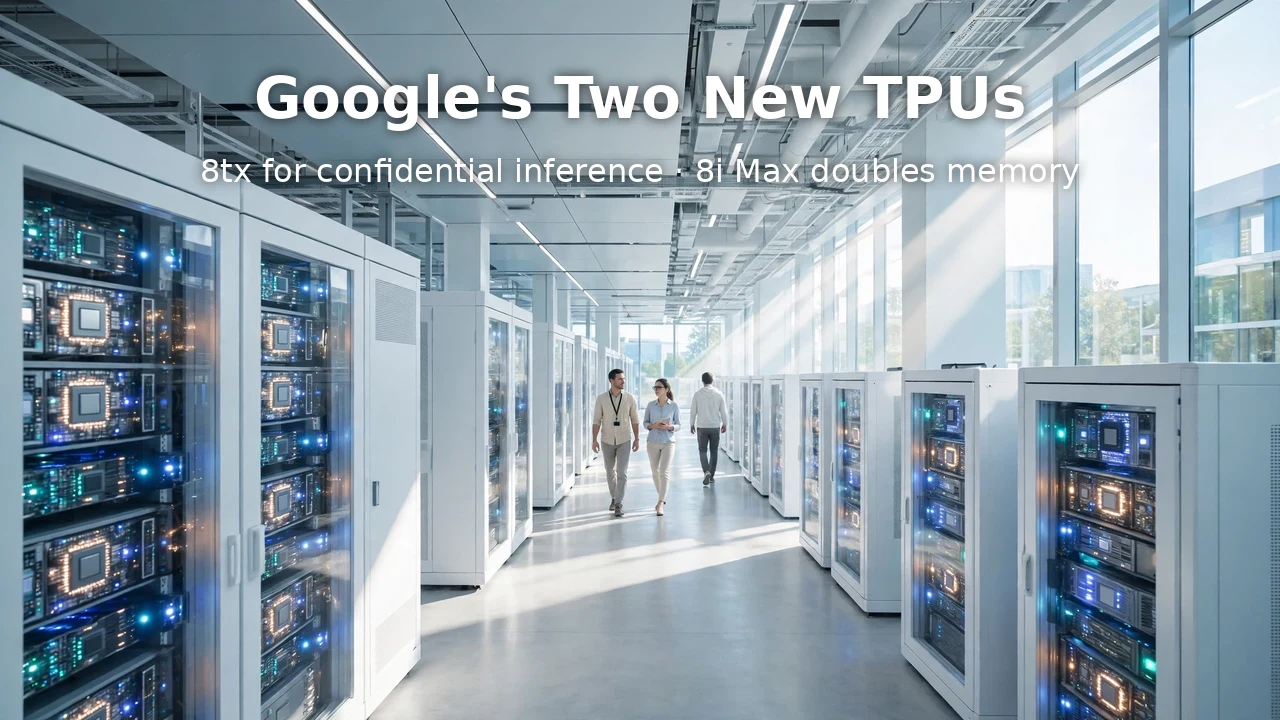
Google said on Nov 9 it is adding TPU 8tx and TPU 8i Max to its eighth-generation TPU lineup, targeting confidential inference and massive context windows — the fourth eighth-generation TPU system introduction this year.
What happened
Amin Vahdat, Google's SVP and chief technologist for AI infrastructure, announced the two systems in an official blog post on Nov 9. They join the 8t for large-scale training and the 8i for real-time reasoning, introduced at Cloud Next in April; Google said it is the first time it has introduced four TPU systems in a single year.
TPU 8tx is built for secure and confidential inference and also suits small-scale training. It uses the same silicon as the 8t, paired with fifth-generation AMD EPYC hosts and the low-latency Boardfly network from the 8i; hardware-level encryption keeps sensitive data and model weights protected and isolated even while in use. Google said it delivers up to 2x lower latency than the 8t with a near-zero performance penalty, and teams can fine-tune, distill and reinforcement-train agents on the same system without moving sensitive data between clusters.
TPU 8i Max targets massive context windows. Google combined two 8i chips onto a single package, doubling the compute, SRAM and HBM bandwidth of a single 8i; twice the silicon fits within the existing rack footprint, raising compute per square foot and per watt. Google did not publish pricing or an availability date for either system.
Key facts
- 8tx role: Confidential inference and small-scale training, for regulated enterprises and governments running frontier models and autonomous agents next to sensitive data
- 8tx hardware: Same silicon as the 8t, fifth-generation AMD EPYC hosts, and the Boardfly low-latency network from the 8i
- 8tx latency: Up to 2x lower latency than the 8t with a near-zero performance penalty, per Google
- 8i Max design: Two 8i chips combined onto a single package
- 8i Max specs: Double the compute, SRAM and HBM bandwidth of a single 8i, for dozens of agents working across a whole codebase or hours of video at once
- Four in a year: The 8t and 8i arrived in April; the 8tx and 8i Max on Nov 9; Google said it is the first time it has introduced four TPU systems in a single year
- Vs prior generation: The 8t offers up to 2.7x better training performance and the 8i 80% better inference price performance, per Google; TPU customers number nearly 100
Why it matters
With four eighth-generation systems in one year, Google is splitting confidential computing and massive context into separate systems, turning the TPU from a general accelerator into workload-specific hardware for agents.
CompaniesGoogle
Follow HIMIAO Horizon
No sign-up · Unsubscribe any timeNotifications
A ping on your phone or computer when the brief is out. No email needed.
Comments
Related
- Oct 29OpenAI Reportedly Plans to Buy Google's AI Chips, the TPUs
- Oct 29Gemini 4 Carbon vs GPT-6.1 Terra: Two New Models in One Week, Double the Price Gap and an 8.4-Point Index Gap
- Oct 29Google Unveils Gemini 4 Carbon: Its Strongest Cybersecurity Frontier Model, Defenders First
- Nov 9Google Backstops Anthropic's $19 Billion Kentucky Lease; Tenant Must Use Google TPUs
- Oct 28Oracle Cloud to Offer Google TPUs From 2027, the First Hyperscale Cloud Outside Google
Today
Nov 10 Tuesday- Brief
- GitHubGitHub Weekly Vol.5: 6 Projects Worth a Look This Week
Tested or read — weeklyAll →
- Quiz
- Call
Latest news
All →- Nov 10Ex-DOE Officials Launch Mavria With $130M to Build Modular Data Centers
- Nov 10Vanta to Acquire AI Agent Security Firm Pillar Security
- Nov 10Adobe and Disney Sign Multi-Year AI Alliance to Build Custom Firefly Models
- Nov 10Anthropic Reports About 100 Korean Enterprise Accounts Leaked, Regulator Confirms
- Nov 10Hardware AI Platform Nominal Raises $240M Series C at $3B Valuation
- Nov 10ChatGPT Enterprise Lands on AWS Marketplace, Payable on AWS Billing