 ™
US Treasury Proposes Expanding High-Tech Investment Curbs: Six Sectors Including AI, Five Countries Listed
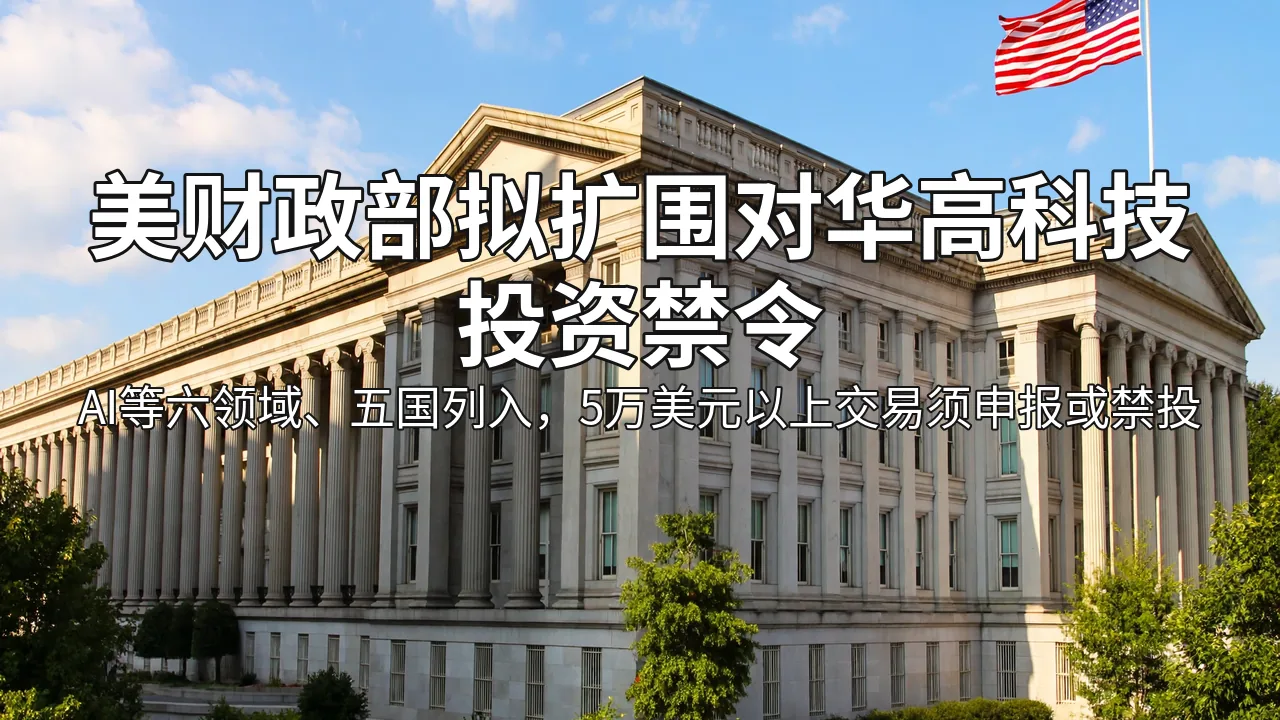
The US Treasury proposed a rule on Oct 22 expanding the Outbound Investment Security Program to six sectors — semiconductors, artificial intelligence, quantum information technology, high-performance computing, hypersonic systems and biotechnology — with transactions split into prohibited and notifiable classes.
What happened
The proposed rule implements the Comprehensive Outbound Investment National Security Act (COINS Act), passed in December 2025 as part of the fiscal year 2026 defense authorization act. Outbound investment screening began with a 2023 executive order, under which Treasury built the Outbound Investment Security Program, effective January 2025, initially covering only mainland China, Hong Kong and Macau. The draft extends the countries of concern to Russia, Iran, North Korea and Cuba; biotechnology was added by Treasury Secretary Scott Bessent under statutory discretion, alongside the five sectors named in the statute: semiconductors, AI, quantum, hypersonics and high-performance computing.
The rule applies only to transactions above $50,000: deals totaling no more than $50,000 over the previous 12 months are exempt from the notification duty, but investments in the prohibited class remain barred regardless of amount; most financial investments, including stock purchases, are excluded. Treasury also offers a confidential, non-binding feedback channel and a national-interest exemption. Public comments are due by Dec 7, 2026, and the existing rules keep applying until final regulations set an effective date. Lawyers and former officials quoted by the Associated Press called the draft the first step in a long process, with final rules expected to carry more enforcement weight.
Bessent said the proposal aims to stop American capital from supporting adversaries' sensitive technologies and to give investors clearer guidance. Chinese Foreign Ministry spokesperson Mao Ning responded that overstretching the national security concept, taking discriminatory measures and restricting normal economic and trade activity serves no one's interests, and that China will monitor developments closely and take necessary measures to safeguard its interests. Enforcement already has a precedent: in July, Treasury fined a US-based company $200,000 for failing to report a $92,500 investment by one of its subsidiaries in a Chinese artificial intelligence and robotics company.
Key facts
- Six sectors: semiconductors and microelectronics, artificial intelligence systems, quantum information technology, high-performance and supercomputing, hypersonic systems, and certain biotechnologies; Treasury uses the term 'superintelligence' for AI.
- Countries of concern: beyond mainland China, Hong Kong and Macau, the draft adds Russia, Iran, North Korea and Cuba; it covers equity transactions, joint ventures and greenfield projects.
- Dollar threshold: applies only to transactions above $50,000; deals totaling $50,000 or less over 12 months are exempt from notification, but prohibited investments are barred regardless of amount; most financial investments, including stock purchases, are excluded.
- Two tracks: transactions are split into prohibited and notifiable classes by technical capability; notifiable deals must be reported to Treasury within 30 days of completion.
- Procedural milestones: comments due Dec 7, 2026; existing rules apply until final regulations take effect; Treasury offers a confidential, non-binding feedback channel and a national-interest exemption.
- Enforcement precedent: in July 2026, Treasury fined a US-based company $200,000 for failing to report a $92,500 investment by its subsidiary in a Chinese AI and robotics company.
Why it matters
this is the first time outbound investment screening covers biotech and hypersonics and extends beyond China to five countries, and the $50,000 threshold brings early-stage venture deals into screening, making compliance review a precondition for China-linked tech investment.
Comments
Related
- Oct 23State Council: Minimize AI's Impact on Workers in Labor-Intensive Industries
- Oct 18Commerce Ministry Notice No. 48: 23 AI Technologies Proposed for Export Control List, Registration Required Before Export
- Oct 15US Treasury Pushes to Rename AI as "Super Intelligence" Globally
- Oct 9Super Micro Contractor Pleads Guilty in $2.5B AI-Chip Smuggling Case
- Oct 9China Issues Guidelines for "New Productive Forces": AI Must Be Safe, Reliable and Controllable
Today
Oct 25 Sunday- Brief
- GitHubGitHub Weekly Vol.2: 6 Projects Worth Your Time
Tested or read — weeklyAll →
- Quiz
- Call
Latest news
All →- Oct 25Google's Five-Year Privacy Pledge Loosens: Email and Photos Connected to Search Can Shape Ads
- Oct 25DeepSeek and MiniMax Approved for Global Use of Their Models: A Go-Ahead Under the Export-Control Draft
- Oct 25Google Privacy Policy Change: Email and Photos Connected to Search Can Shape Personalized Ads
- Oct 25Sweden's Government Offices Block ChatGPT and Claude on Work Computers From Oct 26
- Oct 25AWS Open-Sources Infinity: Agents Suspend While Waiting, So Waiting Costs No Compute
- Oct 241Password Launches Agents Platform: Agent Logins Without Handling Passwords